

Search engines have one job: help people find the most useful result with the least friction. That is why user experience and search ranking can no longer be treated as separate SEO conversations.
But there is a lot of bad advice around this topic.
A slow page can frustrate visitors. A confusing layout can reduce conversions. A weak mobile experience can make people leave. Yet that does not mean every engagement metric in Google Analytics is a direct ranking factor.
The smarter way to think about user experience and search ranking is this: Google uses many systems and signals to surface useful, relevant results, while strong usability helps your content satisfy the people who actually land on it. Google explicitly says there is no single “page experience” ranking signal. Its core ranking systems consider a variety of signals, and Core Web Vitals are among the signals they use.
For growth-focused businesses, UX should not be something the design team fixes after SEO. It should be part of the SEO strategy from the start.
Table of Contents
Why User Experience Matters More in Modern Search
SEO used to be discussed mainly in terms of keywords, links, titles, and crawlability. Those fundamentals still matter, but Google’s guidance increasingly emphasizes helpful, people-first content and an overall satisfying page experience.
That is why user experience and search ranking are connected at the strategy level.
Ask what happens after someone clicks your result. Can they understand the page immediately? Does the main content appear quickly? Can they tap buttons without the layout jumping? Is the answer easy to scan? Can they complete the next action without unnecessary friction?
These questions sit at the intersection of UX and SEO. HelixBeat’s own SEO framework combines user experience, content relevance, technical performance, mobile optimization, authority, and trust rather than treating SEO as keyword placement alone.
The point is simple: a page should not just be optimized for discovery. It should also work well after discovery.
What Google Actually Says About Page Experience
Here is where precision matters.
Google says there is no single page experience signal used for ranking. Instead, its core systems evaluate a variety of signals that align with good page experience. Google also says its web-performance metrics are used by ranking systems, but passing them does not guarantee top rankings.
So user experience and search ranking should never be reduced to “get a perfect PageSpeed score and you will rank higher.”
Relevance still comes first.
Google states that it seeks to show the most relevant content even when the page experience is weaker. But when many pages are similarly useful, a stronger experience can contribute to success in Search.
That is why smart SEO teams treat search ranking factors as an interconnected system instead of a checklist of isolated tricks.
Core Web Vitals: The Confirmed Technical Connection
Core Web Vitals are the clearest measurable connection between technical experience and Google’s ranking systems.
Google currently focuses on three real-world metrics: Largest Contentful Paint for loading performance, Interaction to Next Paint for responsiveness, and Cumulative Layout Shift for visual stability. Google recommends LCP within 2.5 seconds, INP below 200 milliseconds, and CLS below 0.1 for a good experience.
In practical terms:
- LCP: How quickly the main visible content loads.
- INP: How responsive the page feels after interaction.
- CLS: How stable the layout remains while loading.
These metrics matter because user experience and search ranking overlap most clearly when technical performance affects whether a page is actually usable.
But do not optimize the numbers in isolation. A page can pass performance thresholds and still be frustrating if navigation is unclear, content is poorly structured, or intrusive elements block the main information.
That is why page experience signals should support a broader usability strategy, not replace useful content.
What About Bounce Rate, Dwell Time, and CTR?
This is one of the most misunderstood SEO topics.
Marketers often assume that a high bounce rate automatically lowers rankings or that longer dwell time automatically improves them. That is too simplistic.
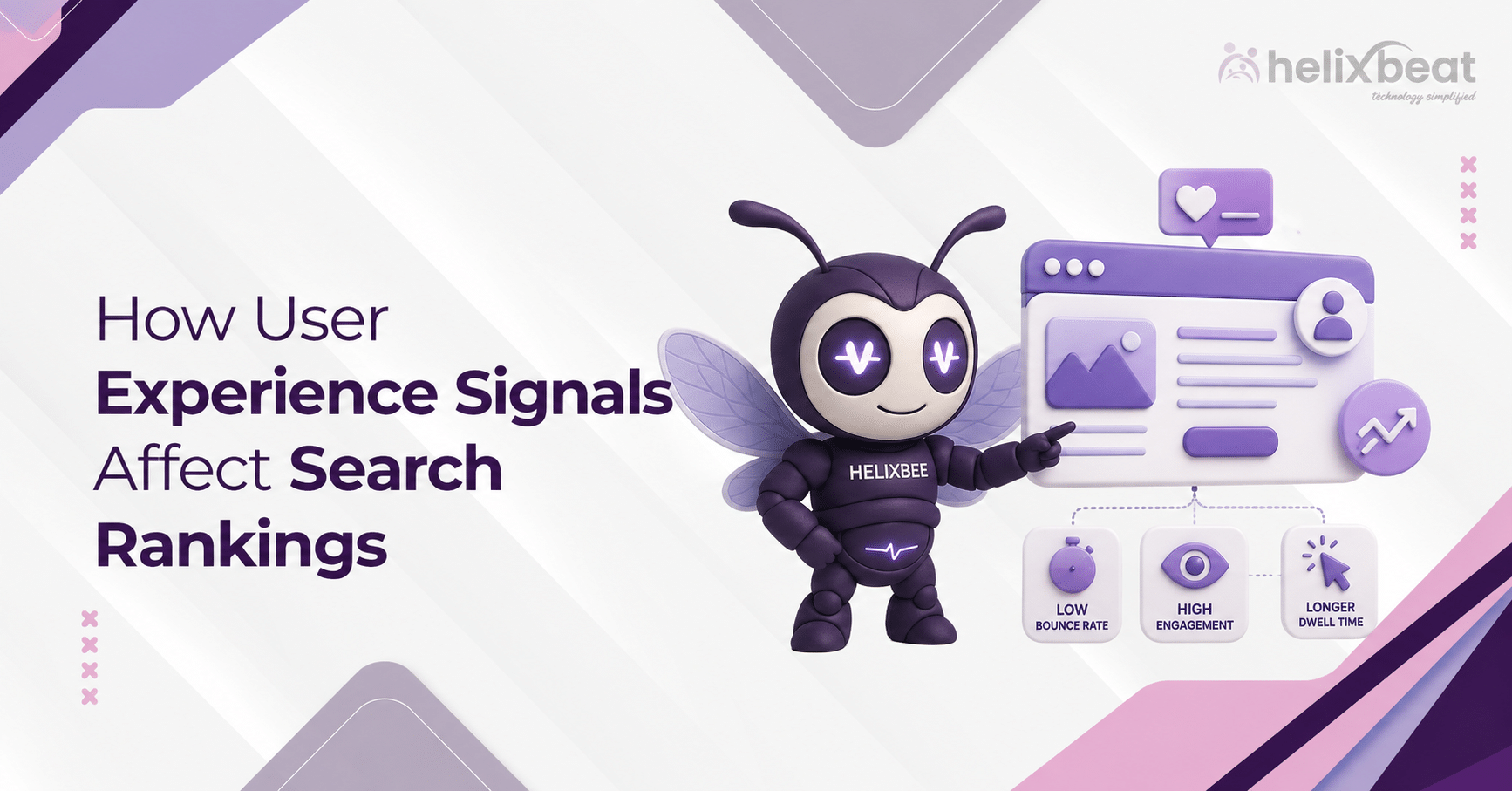
Google has previously clarified that low dwell time or high bounce caused by ads is not, by itself, something that lowers rankings, and Search Engine Journal notes that bounce rate is not a direct ranking factor according to Google.
Should you ignore engagement metrics? No.
Use them as diagnostic signals.
If a page earns impressions but very few clicks, the title or intent may be misaligned. If visitors land and leave immediately, the page may be slow, confusing, irrelevant, or it may simply answer a very simple question quickly. Context matters.
So user experience and search ranking analysis should use behavioral data to identify friction, not treat every analytics metric as a confirmed ranking lever.
Example: A Service Page That Ranks but Does Not Convert
Imagine a B2B software company already ranking on page one for a high-intent service keyword.
The page has strong content and backlinks, but mobile visitors face three problems:
- The hero image loads slowly.
- The “Book a Demo” button shifts while the page is loading.
- The main benefits are buried under a long opening paragraph.
The SEO team could keep building links, but links will not fix the on-page experience.
Instead, the company compresses the hero image, improves loading priority, stabilizes the CTA area, shortens the opening copy, adds clear subheadings, and moves proof points higher on the page.
That produces a better website user experience. Visitors understand the offer faster and reach the conversion action with less friction.
Will those changes guarantee a ranking increase? No.
But they improve usability, responsiveness, content clarity, and conversion potential. Even if rankings stay unchanged, the same organic traffic can become more valuable.
That is the business case for user experience and search ranking optimization: ranking is only useful when the page can turn visibility into meaningful action.
Mobile UX Still Matters
Google uses the mobile version of a site’s content for indexing and ranking through mobile-first indexing.
That means mobile UX cannot be treated as a smaller desktop layout.
A page can look polished on a laptop and still frustrate users on a phone because of tiny tap targets, oversized pop-ups, slow images, difficult forms, or hidden navigation.
HelixBeat’s digital marketing services connect website design with SEO, engagement, measurable performance, and conversion improvement.
For mobile optimization, focus on fast above-the-fold content, readable text, clear tap targets, short forms, visible calls to action, compressed media, simple navigation, and minimal intrusive overlays.
A strong website user experience on mobile also reduces unnecessary friction between discovery and action. Improving these areas strengthens user experience and search ranking strategy while also supporting paid media and conversion performance.
Content Experience Is Part of UX
UX is not just speed and design. Content itself creates an experience.
A visitor should be able to answer three questions quickly:
- Am I in the right place?
- Does this page understand my problem?
- Can I find the answer or next step easily?
Google’s people-first content guidance asks whether readers leave feeling they learned enough to achieve their goal and whether they had a satisfying experience.
That is why user experience and search ranking improves when content is structured around intent rather than keyword repetition.
Use descriptive headings. Lead with the useful answer. Break complex ideas into short sections. Add examples where they make the topic clearer. Remove paragraphs that exist only to increase word count.
Good UX and SEO makes a page easier for people to understand while giving search engines clearer context about the content.
UX in the Age of AI Overviews and AI Mode
Search behavior is changing as Google expands AI Overviews and AI Mode.
Google says there are no special SEO requirements for appearing in these AI features. The same foundational practices still apply, including technical accessibility, indexability, helpful content, and core SEO best practices.
That makes clarity even more valuable.
Pages need to answer specific questions directly, organize supporting information well, and give users a reason to continue beyond the initial answer.
In this environment, user experience and search ranking is not only about winning a traditional blue-link position. It is about creating content that is useful and understandable across increasingly complex search journeys.
How to Improve UX Without Chasing SEO Myths
Start with real problems, not assumptions.
First, use Search Console to identify pages losing clicks or visibility. Then review field performance and check loading, responsiveness, and layout stability. Test important pages manually on real mobile devices.
Next, compare each page with the search intent. Does it answer the query quickly? Is the important information easy to find? Are trust signals visible? Is there a clear next step?
Then use analytics to investigate friction. Engagement patterns can tell you where to look, but do not automatically label bounce rate, scroll depth, or time on page as direct search ranking factors.
Finally, test improvements. Fix one meaningful issue at a time: loading speed, content hierarchy, form length, navigation, CTA placement, or layout stability.
This creates a stronger connection between user experience and search ranking because optimization is based on actual search performance and actual user needs.
A Practical UX Checklist for SEO Teams
Before publishing or refreshing an important organic landing page, ask:
- Does the page satisfy the main search intent?
- Is the primary answer easy to find?
- Does it work well on mobile?
- Are the main visuals optimized?
- Does the interface respond quickly?
- Does the layout remain stable?
- Are forms and CTAs easy to use?
- Is key content blocked by pop-ups?
- Can users scan headings and find important information?
- Is there a useful next step?
This is where page experience signals, content quality, and conversion thinking work together.
How HelixBeat Connects UX With Search Performance
HelixBeat approaches SEO as a complete growth system. Its published framework combines user experience, content relevance, technical performance, mobile optimization, authority, and trust, while its technical SEO work includes site speed, mobile responsiveness, crawlability, and performance optimization.
That integrated approach matters because user experience and search ranking problems rarely belong to one team.
A slow page may require development. A confusing journey may require design. Weak intent alignment may require content. Poor conversion flow may require CRO. Weak search visibility may require SEO.
The strongest results come when those disciplines work together.
For businesses that want to grow organic traffic and leads, user experience and search ranking should be treated as one connected growth challenge. HelixBeat’s marketing approach is built around combining web experience, content, SEO, analytics, and conversion-focused execution.
Final Thoughts
The relationship between user experience and search ranking is real, but it is more nuanced than many SEO shortcuts suggest.
Google confirms that its real-world web-performance metrics are used by ranking systems, while also making clear that there is no single page-experience signal and that strong scores do not guarantee top positions. Relevance and helpful content remain fundamental.
So the goal is not to game user signals.
The goal is to make your page faster, clearer, easier to navigate, more useful, and more satisfying for the person who searched.
That is the strongest long-term way to align user experience and search ranking with modern SEO while turning visibility into business results.
FAQs
- How does user experience affect search rankings?
Good user experience supports SEO by improving speed, usability, mobile performance, content accessibility, and overall visitor satisfaction.
- Are Core Web Vitals a Google ranking factor?
Yes. Google uses Core Web Vitals within its ranking systems, but strong scores alone do not guarantee higher rankings.
- Is bounce rate a direct Google ranking factor?
No. Google has not confirmed bounce rate as a direct ranking factor, but it can help identify UX or content problems.
- How can businesses improve UX and SEO together?
Improve page speed, mobile usability, navigation, content structure, Core Web Vitals, and conversion paths while matching search intent.