

Picture a nurse manager asking a straightforward question: Which discharged patients are still waiting on lab results?
The EHR has a piece of the puzzle, the lab system holds the rest, and the care management tool is completely in the dark. So, what happens next? An analyst ends up exporting two separate spreadsheets and matches them by hand.
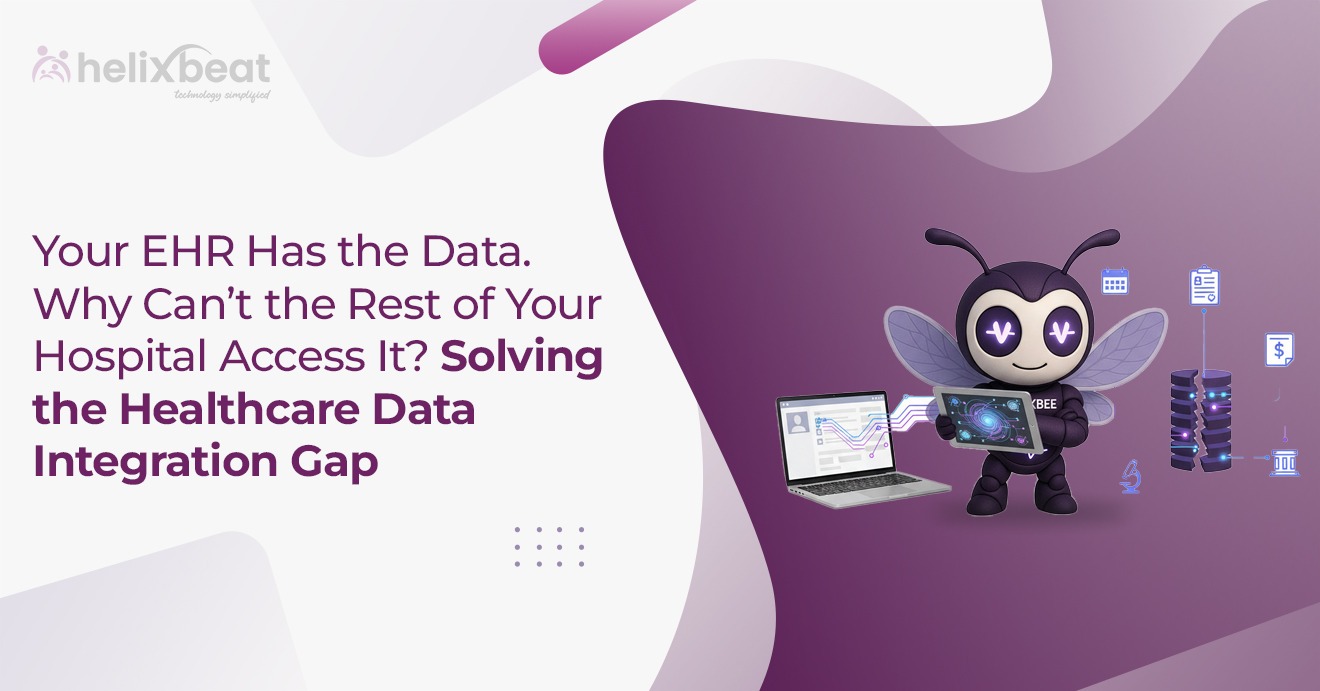
This happens in hospitals every day. The EHR holds a large share of clinical data, yet other departments often cannot reach it in a usable form. Storage is rarely the issue. The real gap is healthcare data integration, and most organizations underestimate how much of it remains unfinished.
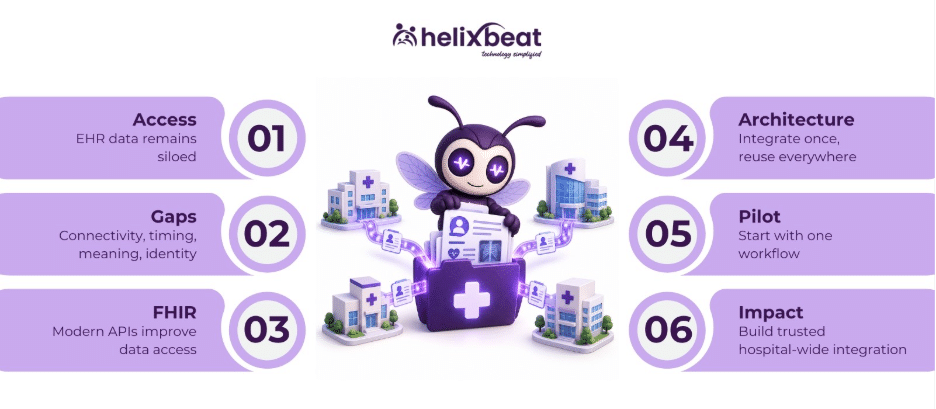
Table of Contents
Why the EHR Feels Like a Locked Room?
An EHR is a system of record. It documents care, supports billing, and meets certification requirements. It was never designed to serve every downstream need.
Three things keep data trapped:
Proprietary data models. Each vendor structures its database differently. Contracts often restrict direct database access, and queries against internal tables tend to break after upgrades.
Interfaces built for one job. Most hospital networks still lean on HL7 v2. While they’re rock-solid for pushing updates like admissions and lab results, they completely choke when you try to ask them a spontaneous, ad-hoc question.
Point-to-point sprawl. Ten systems that all exchange data with each other can need up to 45 separate connections. As a result, each has its own mapping logic, owner, and failure modes.
This sprawl explains why EHR data integration projects stall. Every new request adds another custom link. Thus, healthcare data integration then becomes a maintenance burden instead of a capability.
Four Gaps Hiding Behind “We Can’t Get the Data”
When someone says this, the cause is usually one of four different problems. Healthcare data integration efforts often fail because the team solved the wrong gap.
- Connectivity. No feed exists between the systems. This is the easiest gap to see and fix.
- Timing. A feed exists, but it runs as a nightly batch. Bed management and discharge planning cannot wait until tomorrow. Helixbeat explains why real-time healthcare data exchange still runs late even after interfaces go live.
- Meaning. The data gets through, but a simple lab test might use one code in the lab system and a completely different one in the EHR. You’ve got to map those local terms to a standard dictionary, like LOINC, SNOMED CT, or RxNorm; otherwise, your systems are never going to agree on what they’re seeing.
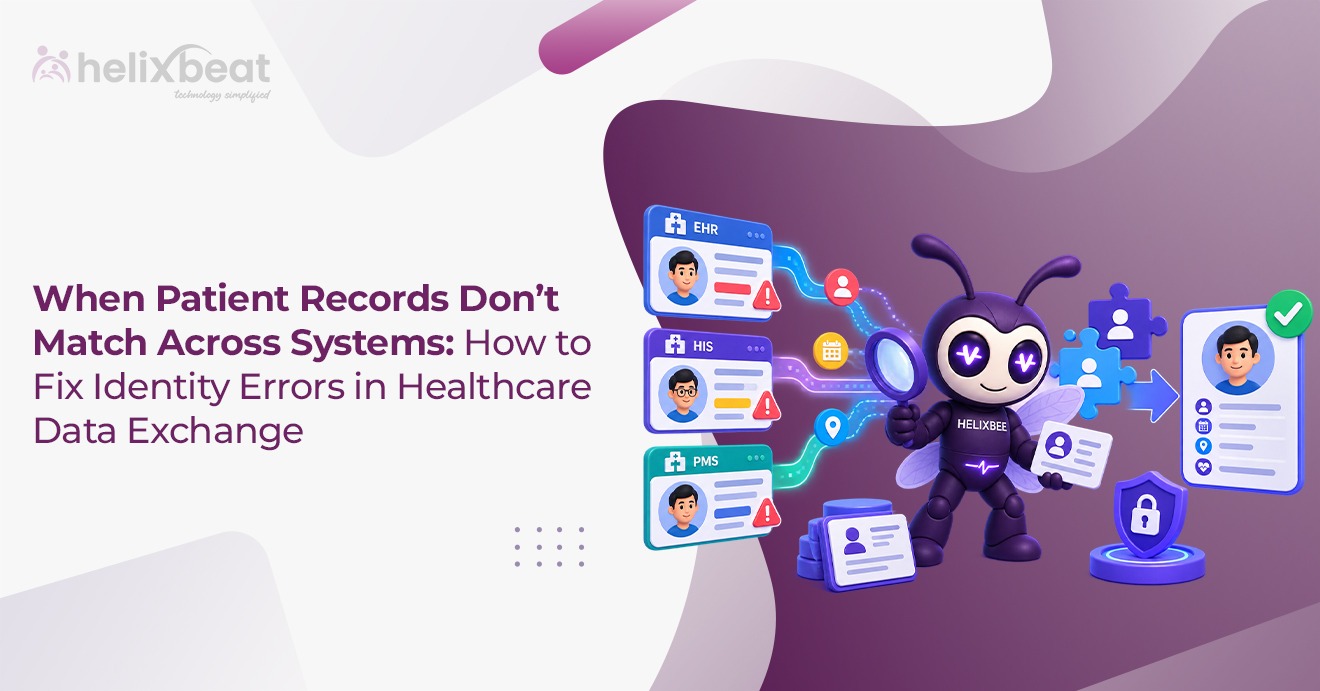
- Identity. The United States has no national patient identifier, so systems match patients on demographics. Therefore, small differences in a name or birth date create duplicates and missed matches.
Where FHIR Helps, and Where It Doesn’t?
FHIR gives developers a web-friendly, resource-based way to read and write clinical data. In the US, ONC certification rules require certified EHRs to support standardized APIs based on FHIR Release 4. That opened doors that had stayed shut for years.
Still, an available API does not mean complete access. Resource coverage, write permissions, and rate limits differ by vendor. Therefore, poor mapping can also return partial records. Helixbeat covers this in its piece on why FHIR APIs return incomplete patient data.
However, the practical view is simple. HL7 v2 and FHIR can coexist inside healthcare information systems. Keep v2 for event streams that already work. Use FHIR where apps, patient access, and analytics need queryable data. Both can belong in a sound healthcare data integration strategy.
An Architecture That Scales: Integrate Once, Reuse Often
Instead of wiring each system to the EHR, place a shared integration layer between them. It typically includes:
- An interface engine to receive, route, and transform messages
- A normalized data store or FHIR server that other systems can query
- A terminology service that maps local codes to standards
- An enterprise master patient index to resolve identity
- Monitoring that alerts a person when a feed slows or fails
Once you have this layer in place, any new department just hooks into it instead of tying directly into the EHR. Suddenly, healthcare data integration becomes a clean, reusable service. Even better, when your EHR goes through an upgrade, your team only has to deal with a single connection instead of untangling a dozen.
AERIS makes healthcare data integration a breeze by supporting you across both the exchange and FHIR layers.
A 90-Day Starting Plan
You do not need an enterprise-wide program to begin. A focused pilot proves the value of healthcare data integration faster.
- Pick one painful workflow. Discharge follow-up, lab results to care management, and ED bed status are common starting points.
- Map every interface that touches it. Record source, format, trigger, owner, and past failures.
- Score the data. Check completeness, timeliness, and consistency on a sample of real records.
- Fix identity and codes first. Feeds built on messy IDs only move the mess faster.
- Publish once. Expose cleaned data through an API and let consumers subscribe to events.
- Watch it run. Track latency, error rates, and queue depth. A quiet interface is not always a healthy one.
Set a baseline first. Measure the hours spent on manual reconciliation and the time needed to answer a cross-department question. Those two numbers build the case for phase two.
The Takeaway
Your EHR is not hoarding data. It is doing what it was built to do. The gap sits in the connections, codes, and identities around it. Close those, and electronic health record integration stops being a series of rescue projects. Start with one workflow, measure it, and build outward. That is how healthcare data integration earns trust across the hospital.
Request a free demo to see how Helixbeat can turn fragmented systems into connected, trusted data flows.
FAQs
- What is healthcare data integration, and how does it differ from interoperability?
Integration is the work of connecting, translating, and consolidating data across systems. Interoperability is the outcome: systems exchange data, and both sides can interpret and use it.
- Why can’t other hospital departments access EHR data directly?
EHR databases are proprietary, direct access is usually restricted by contract, and standard interfaces were built to send specific events. Those events rarely cover every department’s needs.
- Is HL7 v2 obsolete?
No. It remains widely used for admissions, orders, and results. Most organizations run it alongside FHIR rather than replacing it.
- Do we need FHIR to close the gap?
Not always. Many gaps come from timing, coding, or patient identity and can be fixed with an interface engine and cleaner mappings. FHIR helps most when applications need real-time access.
- What is the difference between EHR data integration and electronic health record integration?
The terms overlap, and many teams use them interchangeably. Some use the first for data movement and normalization, and the second for the broader work, including embedding tools in clinician workflows.