


Most hospitals do not have a data shortage. They have a shortage of data that arrives clean, matches the right patient, and lands in a form the receiving system can use. That gap is where many health information exchange projects stall.
The connection itself is rarely the hard part. An interface can go live in weeks. What travels through it is the problem: duplicate patients, local lab codes, free-text allergies, and five spellings of the same drug.
In this blog, we cover what creates that chaos and how to design a health information exchange that avoids it.
Table of Contents
What Data Chaos Looks Like Inside a Health Information Exchange?
Four distinct patterns tend to show up time and time again:
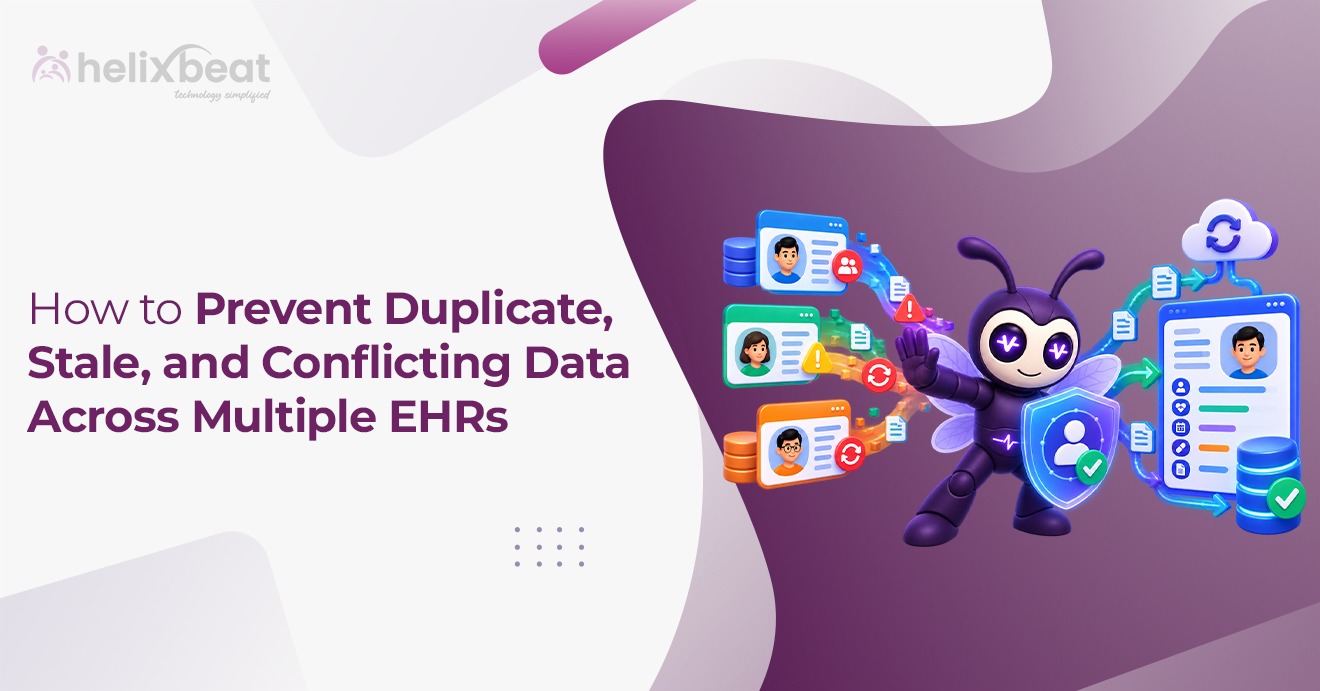
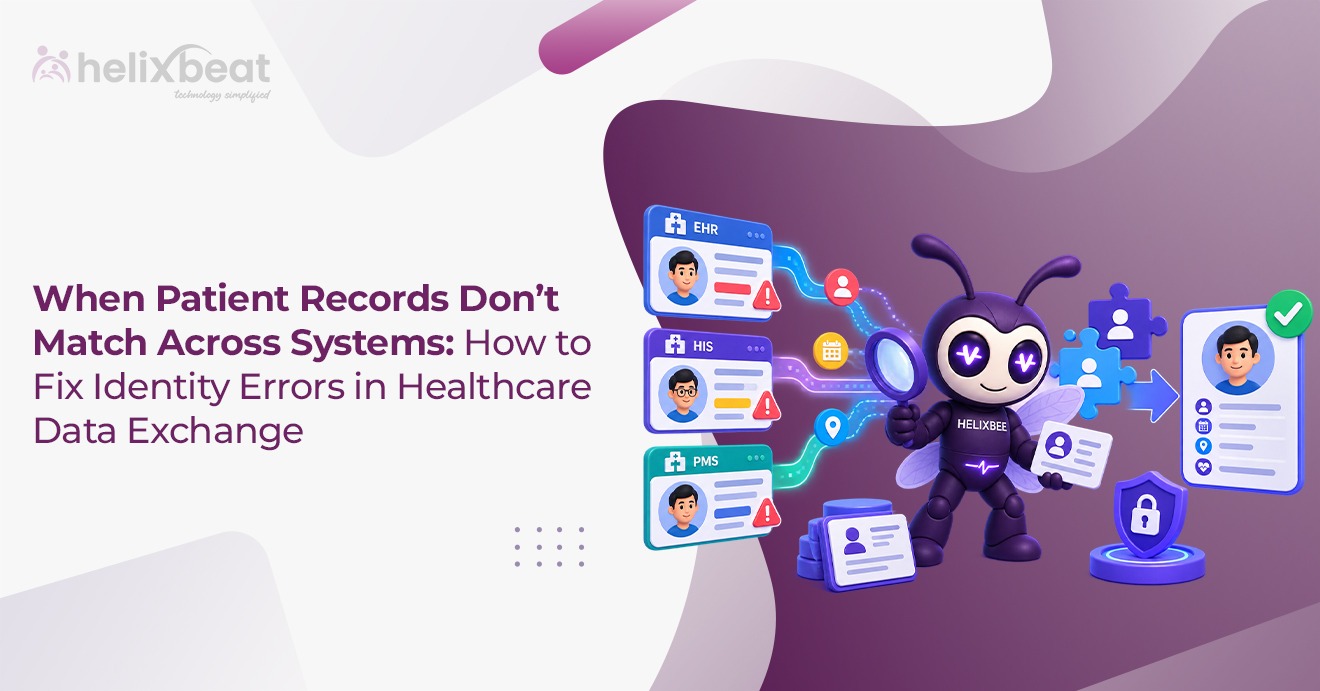
Identity drift. “Anita R. Sharma” in one system is “Anita Sharma” in another. The United States has no national patient identifier, so records get split or wrongly merged.
Local codes. One lab sends “GLU.” Another sends a proprietary number. As a result, the receiving system cannot tell that both mean serum glucose, which LOINC represents as 2345-7.
Format mismatch. One source sends HL7 v2 messages, another sends C-CDA documents, and a third offers FHIR resources.
No data owner. Once a message leaves the source, nobody is accountable for its quality. But someone has to hold that role in healthcare data integration.
Adding more interfaces fixes none of these, but better design does.
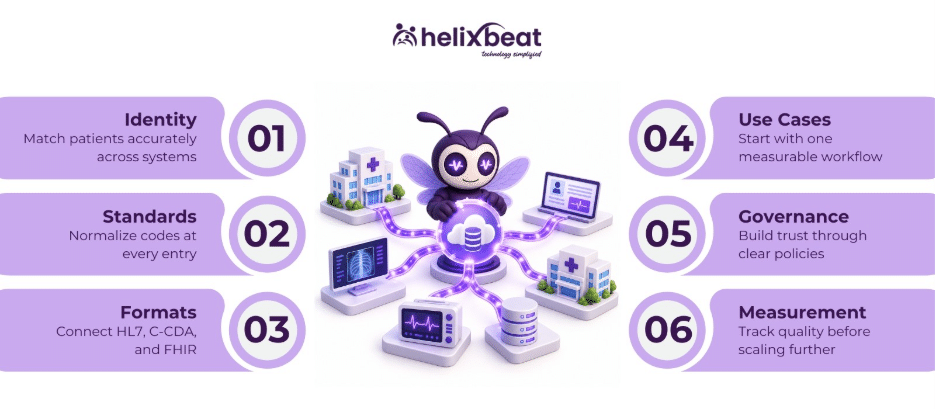
Start With Identity, Not Interfaces
Before you connect a second system, decide how you will recognize one patient across all of them. Most networks use an enterprise master patient index (EMPI), while some add referential matching, which compares records against an outside reference dataset.
Set match thresholds on purpose. In any health information exchange, a false merge can put one person’s allergies in another person’s chart. That is a bigger safety risk than a duplicate record. Therefore, for the first few months, ask a data steward to review the “possible match” queue every week and tune the rules based on what they find.
Normalize at the Edge
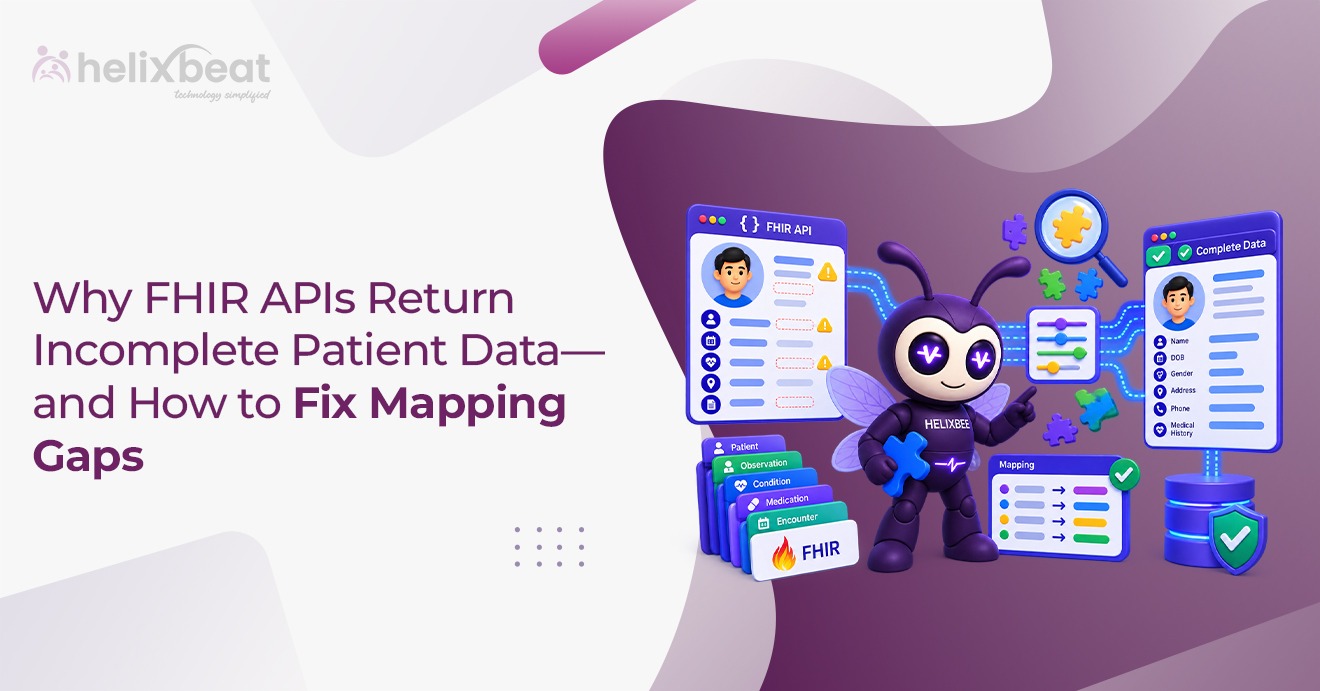
Translate local codes into standard vocabularies as data enters the health information exchange. For example, use LOINC for lab tests, SNOMED CT for clinical findings, RxNorm for US medications, and ICD-10 for diagnoses.
Keep a mapping table and give it an owner. Route unmapped codes to a work queue instead of passing them along silently. This step decides whether healthcare data integration produces something clinicians trust or ignore.
HL7 FHIR architecture, APIs, and implementation walks through how FHIR resources and APIs work and how to put them into practice.
Match the Exchange Pattern to the Use Case
Three models of healthcare information exchange are widely recognized.
- Directed exchange: a secure push, such as a primary care physician sending a referral summary to a specialist.
- Query-based exchange: a clinician searches for records held elsewhere. An emergency physician looking up an unresponsive patient’s history is the classic case.
- Consumer-mediated exchange: patients gather and share their own data through portals or apps.
Do not launch all three at once. Pick one use case with a clear owner and a measurable payoff.
Admission, discharge, and transfer (ADT) notifications are a strong first choice for a new health information exchange. Most hospital systems already emit ADT messages in HL7 v2, so sources need little change. As a result, care teams can act on them right away, for example, by scheduling follow-up after a discharge.
Let HL7 v2, C-CDA, and FHIR Coexist
Waiting for every source to speak FHIR means waiting for years. HL7 v2 still carries much of the daily traffic for labs, orders, and ADT events.
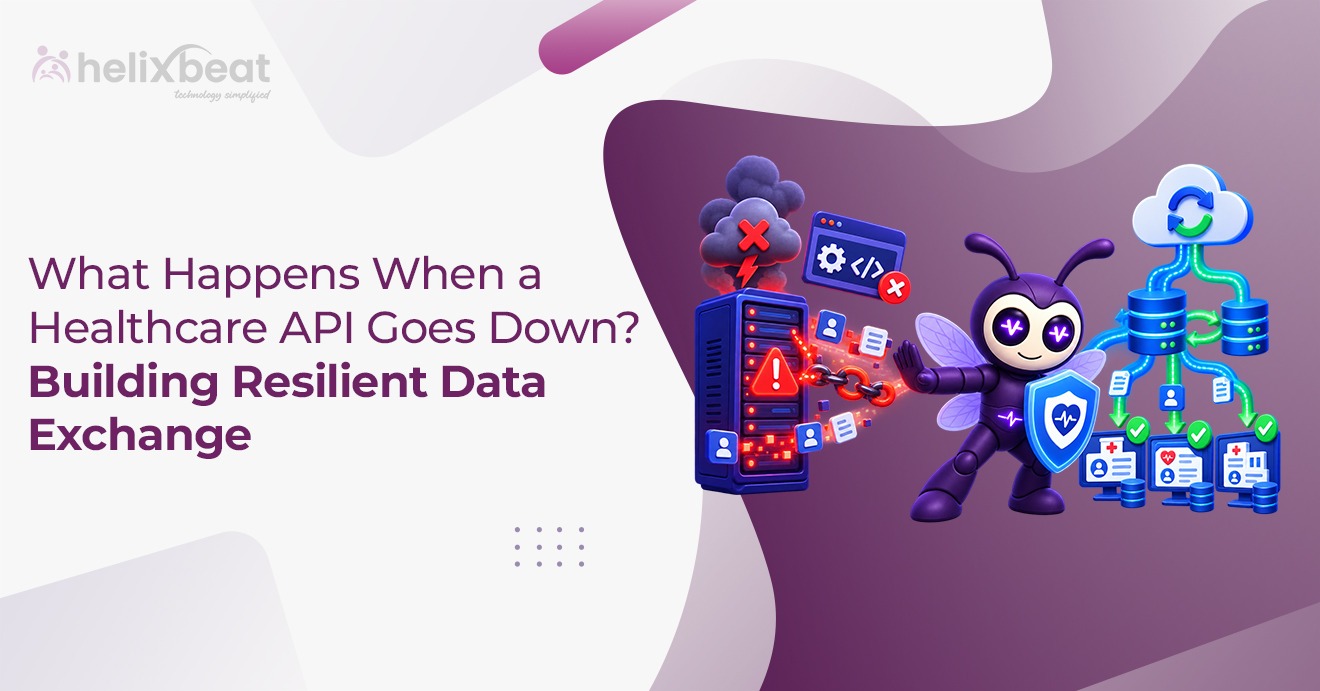
Therefore, a practical design puts an integration engine at the center. It receives v2 messages and C-CDA documents from legacy sources, maps them, and exposes FHIR APIs to newer applications. That’s how existing systems keep running while new consumers get modern access.
There is one more test. Interoperable electronic health records need more than delivery. The receiving EHR has to file the data as structured, coded, source-attributed entries. A scanned PDF can be read, but nobody can trend it or run decision support on it. This is where AERIS plays a big role. It is a data-exchange layer that supports both HL7 v2 messaging and FHIR standards.
Governance Decides Whether People Trust the Data
Technical work alone does not earn trust in healthcare information exchange. Agree on consent, access, and audit rules before go-live.
In the US, HIPAA permits disclosures for treatment without patient authorization. Other rules can be stricter. For example, certain substance use disorder treatment records fall under 42 CFR Part 2, and many states add their own limits. Build these rules into the health information exchange as policy.
US organizations should also look at TEFCA, the national framework that connects networks through Qualified Health Information Networks (QHINs).
A 90-Day Starting Plan
- Weeks 1-4, inventory. List every feed with its sender, format, volume, and owner. Profile 30 days of traffic for missing fields and unmapped codes.
- Weeks 5-8, foundations. Stand up identity matching and terminology mapping for one use case.
- Weeks 9-12, go live and measure. Track duplicate rate, unmapped-code rate, event-to-delivery time, and the share of received records clinicians actually open. Expand only when those numbers improve.
The Real Measure of Success
A strong health information exchange is not the one with the most connections. It is the one where a clinician opens a record and trusts what is in it. Fix identity, standardize vocabulary, choose one use case, and govern the rules. Then scale.
See how AERIS can strengthen your health information exchange. Request a free consultation to explore a focused pilot.
FAQs
- What is a health information exchange?
It is the electronic sharing of patient data among authorized organizations such as hospitals, labs, pharmacies, and clinics. The term also refers to the organizations that operate these networks.
- How is interoperability different from HIE?
Interoperability is the ability of systems to exchange and use data. HIE is the practice and infrastructure that carries out the exchange.
- Do we need to replace our EHR to join an HIE?
Usually not. Most organizations connect through interfaces, an integration engine, or FHIR APIs. A replacement is only relevant if the EHR cannot send standard messages at all.
- Which standards matter most?
HL7 v2 for messaging, C-CDA for documents, and FHIR for APIs. LOINC, SNOMED CT, RxNorm, and ICD-10 cover vocabulary. IHE profiles describe how these pieces fit together.
- How do exchanges match patients without a national ID?
They typically use an enterprise master patient index with rule-based or probabilistic matching. Some add referential matching. Clean demographic data improves every method.