

A patient updates her phone number at a clinic on Monday. By Friday, the hospital across town still holds the old one. The lab also spells her surname differently. But nobody made a mistake. The systems simply never agreed on what “the record” is.
That is everyday life for electronic health record data. It sits in many places, gets edited by many people, and travels through interfaces built at different times for different jobs. Below, we look at why it drifts apart and what keeps it aligned.
Table of Contents
Where inconsistency really starts?
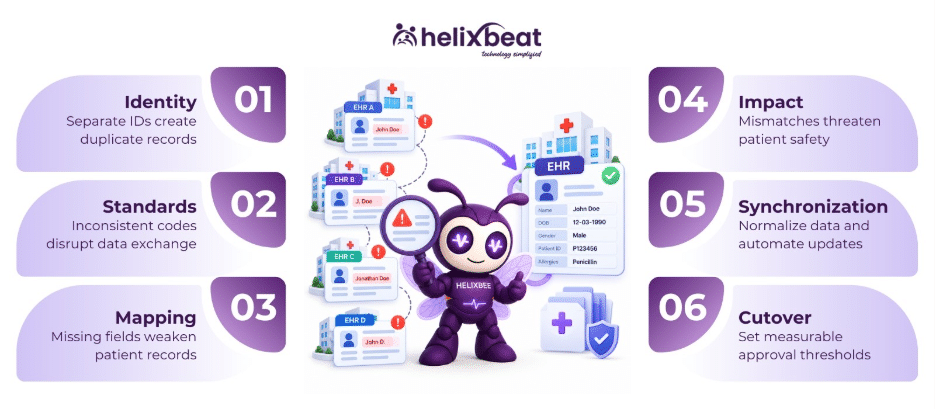
- Identity is matched, not shared. The US has no national patient identifier, so every system issues its own ID. Linking them depends on name, birth date, and address. For instance, “Bob” versus “Rob,” or a hyphenated surname typed two ways, produces duplicates. Worse, it can merge two different people. Our piece on patient matching in healthcare explains how these mismatches appear across systems.
- Standards leave room for local choices. HL7 v2 and FHIR both allow variation. One system sends a lab result with a LOINC code, while another sends a home-grown code. One codes a diagnosis in ICD-10-CM, another in SNOMED CT. Units add friction as well: glucose in mg/dL on one side, mmol/L on the other. Each message is valid, yet the data they carry doesn’t communicate.
- Mapping drops detail. Fields get truncated, free text gets flattened, and optional elements are skipped. This is a frequent reason FHIR APIs return incomplete patient data.
- Updates travel late or not at all. Some interfaces announce a new record but not every edit. Nightly batch jobs leave gaps of hours. Therefore, if two systems change the same field between syncs, one change usually overwrites the other.
- Copies pile up. Allergy, medication, and problem lists are copied between systems and rarely cleaned. Over time, stale entries sit beside current ones.
Why it matters beyond tidiness?
A clinician who sees an incomplete allergy list may prescribe without the full picture. A mismatched birth date can trigger a claim denial. Duplicate charts lead to repeated tests. Therefore, when electronic health record data disagrees between systems, the result is a safety and cost problem. Strong healthcare data management starts by treating that disagreement as a measurable defect.
How to keep patient data synchronized?
- Name a system of record for each data element. Registration owns demographics. The clinical system owns allergies. The lab owns results. Every other platform reads from the owner and does not edit its own copy. Think of EHR data as a set of fields with owners, not one shared pile.
- Run a master patient index with a review queue. Use probabilistic matching, and set a high threshold for automatic links. Send borderline pairs to a data steward instead of guessing. IHE profiles such as PIX and PDQ give you standard ways to cross-reference identifiers and query demographics.
- Normalize data on the way in. Convert incoming messages to one internal model, often FHIR. Validate against a profile such as US Core. Map local codes to LOINC, SNOMED CT, and RxNorm through a terminology service. Convert units and store dates in ISO 8601. Once electronic health record data lands in one model, comparing it becomes simple.
- Send changes as events. In HL7 v2, an ADT A08 message carries demographic updates, and A40 carries patient merges. In FHIR, Subscriptions can notify other systems when a resource changes. Event-driven exchange brings the gap close to real time. AERIS is built for real-time data sharing across systems.
- Plan for conflicts. Record who changed what and when. The Provenance resource captures that. Also, versioned updates using If-Match headers stop one system from overwriting a newer edit without noticing.
- Reconcile on a schedule. Compare record counts and key fields between systems each week. Track the mismatch rate of your electronic health record data as a metric. A rising number points to a broken interface before clinicians notice.
- Test and monitor the interfaces. Replay edge cases such as name changes, merges, and corrections before go-live. Our API and integration testing and healthcare API reliability cover this work in more detail.
What a clean update looks like?
Say registration corrects a patient’s surname. The registration system sends an ADT A08 message. The master patient index confirms it is the same person. The FHIR server updates the Patient resource and increments its version. Subscribed systems receive the change within moments, and the weekly reconciliation report shows zero mismatches for that patient. Each step is small. Together, they keep electronic health record data consistent across every connected system.
Where to start this month?
Pull a sample of 500 patients and compare each patient’s electronic health record data across your EHR platforms. List the ten fields that disagree most often. Look at where each value is first entered and how it is read downstream. Fix those fields at the source, then add a rule so they cannot drift again. Small, measurable wins build the case for broader healthcare data management work.
Ready to improve healthcare data consistency across systems? Get in touch with us!
FAQs
- Why does the same patient have different details in two EHRs?
Each system captures and stores data on its own. Without one agreed owner for each field, edits made in one place don’t always reach the other.
- What is a master patient index?
It is a service that links the different IDs a patient has across systems into one identity. It uses demographics and matching rules to do this.
- Does FHIR remove inconsistency on its own?
No. FHIR gives systems a common structure, but local codes, optional fields, and different mapping choices can still produce differences.
- What is the difference between HL7 v2 and FHIR?
HL7 v2 is a message-based standard used widely for events such as admissions, orders, and results. FHIR is a newer, resource-based standard that uses web APIs.
- How often should records be reconciled?
Weekly is a practical starting point for key fields. High-risk data such as allergies and medications may need daily checks.
- What causes duplicate patient records?
Typical causes are spelling variations, nicknames, changed names, typing errors at registration, and weak matching rules.
- Which data elements should have a single owner first?
Start with demographics, allergies, medications, and problem lists. Errors in these fields carry the most clinical and billing impact.