

A modern financial data warehouse is no longer just a storage layer—it has evolved into a strategic decision-making engine that drives business growth. As enterprises process massive volumes of financial data every day, outdated systems often create performance bottlenecks and limit real-time insights.
This is where Helixbeat DaaS enables a shift toward a smarter hybrid architecture. A well-designed financial data warehouse combines the flexibility of cloud environments with the control of on-premises systems, ensuring improved performance, scalability, and regulatory compliance.
Today’s data warehouse financial services are engineered for speed, accuracy, and advanced analytics—empowering enterprises to stay competitive and agile in a rapidly evolving digital economy.
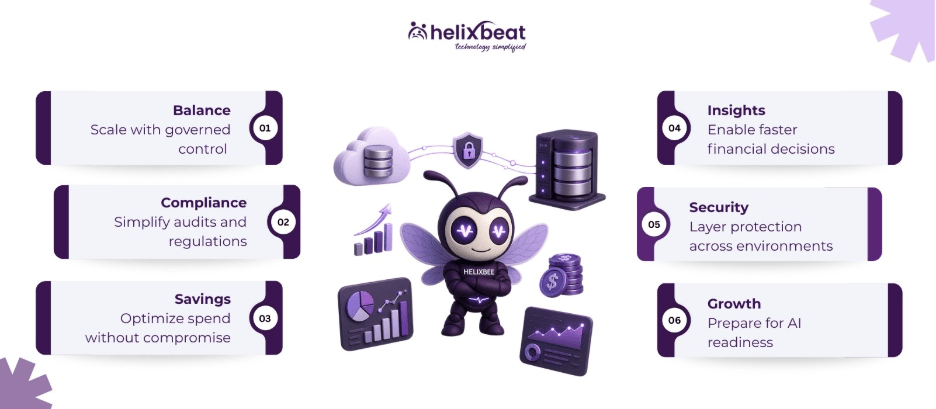
Table of Contents
Top Reasons Every Enterprise Needs a Financial Data Warehouse in 2026
Enterprises in 2026 are shifting toward intelligent data systems that balance performance, compliance, and scalability. A modern financial data warehouse plays a central role in enabling this transformation.
1. A Hybrid Financial Data Warehouse Balances Scalability and Control
A hybrid approach allows enterprises to combine flexibility with strict data governance, ensuring optimal performance across environments.
A hybrid model ensures you don’t have to choose between flexibility and security. It offers the best of both environments within a financial data warehouse ecosystem.
How it works
- Cloud handles high-volume processing and scalability
- On-premise systems secure sensitive financial data
- Workloads can be shifted based on demand
Why it matters
Enterprises can scale operations efficiently without exposing critical financial data. This balance is especially important for organizations relying on business management software integrated with financial systems.
2. Hybrid Financial Data Warehouses Strengthen Regulatory Compliance
Regulatory pressure is increasing, and enterprises need structured systems to manage compliance efficiently.
Meeting compliance requirements becomes easier with a hybrid finance data warehouse, especially in regulated industries.
Key compliance benefits
- Sensitive data remains in controlled environments
- Easier audit trails and reporting
- Better adherence to regional data regulations
Real-world impact
Organizations using data warehouse financial services can generate compliance reports faster, reducing risk exposure and regulatory penalties.
3. Hybrid Models Enable Smarter Cost Optimization (FinOps)
Cost efficiency is a major driver behind the adoption of hybrid architectures in modern enterprises.
Hybrid models help organizations optimize infrastructure spending while maintaining performance and reliability.
Cost comparison
| Component | Cloud Only | On-Premise Only | Hybrid Model |
| Initial Investment | Low | High | Moderate |
| Scalability Cost | High (variable) | Low | Optimized |
| Maintenance | Low | High | Balanced |
| ROI | Medium | Slow | High |
Key advantages
- Reduces unnecessary cloud spending
- Avoids heavy infrastructure investments
- Aligns IT spending with business goals
4. Hybrid Financial Data Warehouses Deliver Real-Time Insights
Financial decision-making today depends on speed, accuracy, and real-time visibility across systems.
Hybrid architectures enable organizations to unify data streams for faster insights and better outcomes.
Capabilities
- Real-time transaction analysis
- Faster financial reporting
- Instant access to key metrics
Business benefits
A hybrid financial data warehouse ensures decision-makers always have updated insights, enabling faster and more confident business decisions through integrated business management software systems.
5. Hybrid Architecture Enhances Data Security Layers
Security remains a top priority when managing sensitive financial systems and enterprise data environments.
Security features are a core strength of a modern financial data warehouse built on hybrid architecture.
Security features
- On-premise storage for critical financial data
- Cloud-based encryption and continuous monitoring
- Data segmentation to reduce exposure risks
Why enterprises trust hybrid
This layered security approach ensures that even if one environment is compromised, the entire finance data warehouse remains protected through isolation and controlled access mechanisms.
6. Hybrid Systems Ensure Strong Disaster Recovery and Business Continuity
Operational downtime can directly impact revenue, trust, and financial performance.
Hybrid systems are designed to ensure resilience, continuity, and rapid recovery across distributed environments.
Key features
- Data redundancy across cloud and on-premise environments
- Faster backup and recovery processes
- Minimal downtime during system failures
Outcome
Modern data warehouse financial services ensure uninterrupted operations, even during unexpected disruptions or infrastructure failures.
7. Hybrid Data Warehouses Integrate Seamlessly with Business Management Software
Integration across enterprise systems is essential for operational efficiency and accurate decision-making.
A well-designed financial data warehouse enables seamless connectivity between data systems and enterprise applications.
Integration advantages
- Smooth data flow across departments
- Compatibility with ERP and analytics platforms
- Reduced manual data handling and duplication
Result
Enterprises can connect their finance data warehouse with business management software, improving operational efficiency, data accuracy, and cross-functional collaboration.
8. Hybrid Financial Data Warehouses Enable Advanced Analytics and AI
Modern enterprises generate value when raw data is transformed into predictive intelligence.
Hybrid architecture enables scalable analytics without compromising performance or security.
Capabilities unlocked
- Predictive financial modeling
- AI-driven business insights
- Advanced risk and trend analysis
Impact on business
A hybrid financial data warehouse empowers organizations to leverage AI and advanced analytics while maintaining secure and high-performance data operations.
Turn your data into actionable intelligence—upgrade your hybrid financial data warehouse today.
9. Hybrid Financial Data Warehouses Improve Business Agility
Business agility is essential for staying competitive in rapidly evolving markets.
Hybrid systems allow enterprises to adapt quickly without infrastructure limitations.
How hybrid drives agility
- Flexible workload distribution across environments
- Faster deployment of new data solutions
- Quick adaptation to market changes
Business value
Organizations can innovate faster and respond more effectively to customer demands and market shifts.
Helixbeat DaaS Simplifies Hybrid Financial Data Warehouse Adoption
Selecting the right partner is critical for successful implementation and scalability.
Helixbeat provides enterprise-ready frameworks designed for modern data ecosystems.
What Helixbeat offers
- Seamless integration of cloud and on-premise systems
- Scalable data warehouse financial services
- Strong security and compliance frameworks
Why choose Helixbeat
With Helixbeat DaaS, enterprises can build a future-ready financial data warehouse without operational complexity, ensuring long-term scalability, performance, and governance.
Wrapping Up
A hybrid financial data warehouse is becoming the foundation of enterprise success in 2026. It delivers the right balance of flexibility, security, and efficiency needed for modern digital transformation.
Key takeaways
- Hybrid models ensure scalability while maintaining control
- They optimize costs and improve decision-making
- They prepare enterprises for AI-driven, data-first operations
FAQs
1. What is a hybrid financial data warehouse?
A hybrid financial data warehouse combines cloud and on-premise systems to manage financial data efficiently and securely.
2. Why are enterprises adopting hybrid data warehouse financial services?
They offer better scalability, cost control, compliance, and performance compared to traditional systems.
3. How does a hybrid finance data warehouse reduce costs?
It optimizes resource allocation by balancing cloud usage and on-premise infrastructure, reducing unnecessary expenses.
4. Can hybrid financial data warehouses integrate with business management software?
Yes, they seamlessly integrate with business management software, enabling better data accessibility and operational efficiency.