

India’s rapid digital expansion has made data compliance a business priority, and a secure data warehouse with Helixbeat is now essential for modern enterprises. As regulations like the DPDP Act tighten governance requirements, organizations must rethink how they design, manage, and secure data ecosystems across cloud and hybrid environments.
Helixbeat enables enterprises to move beyond traditional systems by building a secure, scalable, compliant, and analytics-driven data warehouse architecture that aligns with both regulatory requirements and business growth.
This foundation ensures stronger data security, improved analytics capabilities, and a robust data warehouse management system for enterprises operating in India’s rapidly evolving digital economy, built for long-term scale and performance.
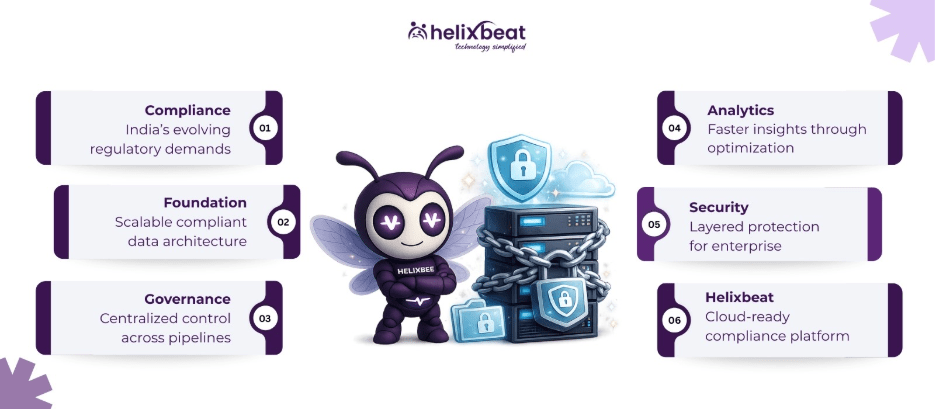
Table of Contents
What makes a secure data warehouse essential for India’s compliance-driven economy?
A secure data warehouse is becoming the backbone of India’s regulated digital ecosystem. Enterprises must balance innovation with strict compliance requirements while ensuring strong data security in data warehouse environments.
Rising compliance demands and governance challenges
India’s DPDP Act and industry-specific regulations demand complete control over data lifecycle management. This makes a secure data warehouse architecture mandatory for modern enterprises handling sensitive and regulated data.
Building trust through structured data systems
Organizations must ensure transparency, accuracy, and accountability in how data is stored and used. A well-designed data warehouse management system strengthens trust with regulators and customers while improving governance.
At Helixbeat, we help enterprises design a secure data warehouse aligned with India’s compliance-first digital economy.
How does a data warehouse management system improve analytics and compliance?
A robust data warehouse management system ensures structured control over enterprise data operations. It connects governance, compliance, and data analytics and data warehousing into one unified and efficient framework.
Centralized governance for enterprise data control
Centralized systems help enforce policies across all data pipelines, ensuring consistency and strengthening data security in data warehouse environments while reducing operational risks.
Enhancing data analytics and data warehousing efficiency
Modern platforms improve data analytics and data warehousing by enabling faster data processing and optimized storage. This leads to real-time insights and more informed business decisions.
Automation for audit readiness and monitoring
Automated tracking ensures that all data activities are recorded and monitored continuously. This simplifies audits, strengthens compliance reporting, and enhances data security in data warehouse systems.
What is Helixbeat Dwaas and how does it transform secure data warehousing?
Helixbeat Dwaas (Data Warehouse as a Service) is a modern cloud-native solution designed for scalable and secure enterprise data management. It simplifies infrastructure complexity while enabling a secure data warehouse built for compliance and performance.
Simplified deployment with enterprise-grade security
Helixbeat Dwaas removes infrastructure overhead while maintaining strong data security in data warehouse environments. This allows enterprises to focus on insights rather than system maintenance.
Built-in compliance and governance framework
The platform integrates compliance policies directly into its architecture, ensuring that every secure data warehouse deployment meets regulatory requirements from the start.
Scalable architecture for growing data needs
Enterprises can scale storage and processing capabilities without compromising performance. This makes it ideal for supporting advanced data analytics and data warehousing in India’s fast-growing digital economy.
Helixbeat Dwaas empowers businesses to modernize their secure data warehouse systems with agility, compliance, and intelligence.
How can organizations improve data security in data warehouse environments?
Data security is the foundation of any enterprise data strategy. Without strong protection layers, even the most advanced systems remain vulnerable to breaches and compliance risks.
Encryption and advanced protection layers
Sensitive data must be encrypted both at rest and in transit. This ensures strong data security in data warehouse environments and protects against unauthorized access or leakage.
Strengthening data security in data warehouse systems
Role-based controls, masking techniques, and monitoring frameworks significantly reduce exposure risks. A well-designed data warehouse management system enhances overall data security in data warehouse environments by enforcing structured protection policies.
Continuous threat monitoring and response systems
AI-driven monitoring tools detect anomalies in real time and trigger automated responses. This strengthens the resilience of modern data analytics and data warehousing platforms while ensuring proactive threat mitigation.
What role does data warehouse access control play in compliance and governance?
Data warehouse access control defines how users interact with enterprise data systems and ensures that only authorized individuals can access sensitive information.
Role-based access and privilege management
Permissions are assigned strictly based on job roles and responsibilities. This structured data warehouse access control approach reduces internal risks and strengthens governance.
Audit trails and accountability tracking
Every action within the system is logged for transparency and traceability. This improves compliance readiness within modern data analytics and data warehousing environments.
Zero-trust approach for stronger security
No user or system is automatically trusted. Every access request is verified before approval, reinforcing strong data security in data warehouse frameworks.
How to build a future-ready, secure data warehouse for India?
Future-ready systems must align with compliance, scalability, and innovation requirements. Building them requires a strategic, layered architecture approach.
Cloud-native and hybrid infrastructure adoption
Hybrid systems provide flexibility while maintaining regulatory compliance. They ensure sensitive data remains within jurisdictional boundaries in a secure data warehouse setup.
Embedding compliance into architecture design
Compliance must be built into system design, not added later. This reduces operational risks and strengthens governance within a data warehouse management system.
AI-powered automation and optimization
Automation enhances performance, monitoring, and anomaly detection. It strengthens both efficiency and data security in data warehouse environments while improving scalability.
Helixbeat helps enterprises design a future-ready secure data warehouse powered by strong governance, scalability, and advanced data analytics and data warehousing capabilities.
Wrapping Up
A secure data warehouse is essential for India’s compliance-driven digital future. Enterprises must combine governance, scalability, and strong data warehouse access control to remain competitive and secure.
Key takeaways
- Build compliance into system architecture from the beginning
- Strengthen security using encryption and data security in data warehouse controls
- Adopt scalable solutions like Helixbeat Dwaas for future readiness supported by a robust data warehouse management system
FAQs
1. What is a secure data warehouse?
It is a data storage system designed with built-in security, compliance, and governance controls to protect enterprise data.
2. How does Helixbeat Dwaas help enterprises?
Helixbeat Dwaas provides a scalable, cloud-based data warehouse solution with built-in security, compliance, and performance optimization.
3. Why is data warehouse management system important?
It ensures centralized governance, automation, and compliance across all enterprise data operations.
4. What is data warehouse access control?
It is a security mechanism that defines who can access, modify, or analyze data within a warehouse system.