

With digital health moving so fast, sharing health information has become a major part of changing how patient data flows. Fast Healthcare Interoperability Resources (FHIR), a standard developed by Health Level Seven International (HL7), plays a key role in this shift. Combined with Health Information Exchanges (HIEs), FHIR facilitates seamless data sharing among providers, payers, and patients.
In this blog, we’ll take a look at how combining FHIR with HIEs makes the entire healthcare data world work better as a single, cohesive unit.
Table of Contents
FHIR: The Foundation of Modern Healthcare Information Exchange
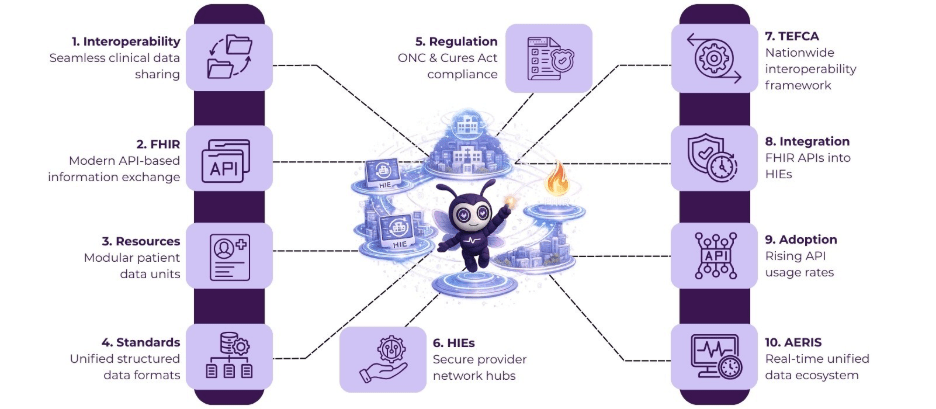
FHIR represents a next-generation standard for electronic health data exchange. Released in 2014, FHIR builds on web technologies like RESTful APIs, JSON, and XML to enable efficient data transmission. Unlike older standards such as HL7 v2 or CDA, FHIR organizes data into modular “resources” – discrete units like Patient, Observation, or MedicationRequest. These resources enable systems to query and retrieve specific information without transferring entire records.
FHIR Release 5 (R5), published in March 2023, includes expanded definitions and improvements to the specification that support a wider range of clinical scenarios. Work on future versions like R6 continues, with the goal of advancing semantic interoperability and maturing more resources.
In the United States, certification criteria related to FHIR APIs continue to evolve under initiatives like the ONC Health IT Certification Program and the 21st Century Cures Act, which promote the use of standardized APIs to facilitate patient data access and interoperability. Many certified health IT products now incorporate FHIR APIs to help meet regulatory expectations and support real‑time data exchange in clinical workflows.
The Role of Health Information Exchanges in Data Sharing
Health Information Exchanges (HIEs) act as secure networking hubs that permit authorized healthcare providers to share clinical information across systems. HIEs grew out of broader federal efforts to promote electronic records and interoperability, including initiatives under the HITECH Act.
The Trusted Exchange Framework and Common Agreement (TEFCA) boost nationwide interoperability by enabling Qualified Health Information Networks (QHINs) to share health information. As part of ongoing CMS interoperability efforts, networks moving toward TEFCA alignment are expected to offer access to data using FHIR APIs that adhere to the US Core Data for Interoperability (USCDI) Version 3 or later by mid‑2026.
Therefore, when you share clinical data through an HIE, you’re following the federal roadmap for a fully integrated healthcare system. Similarly, recent CMS initiatives, such as the Interoperability Framework and the Health Technology Ecosystem, also encourage the development of digital tools, including those powered by AI, for enhanced data access and patient engagement.
Integrating FHIR with HIEs for Enhanced Interoperability
The integration of FHIR with Health Information Exchanges (HIEs) plays a growing role in advancing interoperability in healthcare. Because FHIR uses APIs for standard data access, it fits right in with the secure HIE networks that route patient data. For example, a HIE can leverage FHIR APIs to retrieve specific clinical data elements, such as immunizations or lab results, from an Electronic Health Record (EHR) and share that information with participating providers in real time.
Use of FHIR APIs has risen significantly in U.S. hospitals in recent years. According to government data, more than two‑thirds of non‑federal acute care hospitals reported using standards‑based APIs (largely FHIR) to enable patient access to data through apps, a marked increase compared with previous years. This trend is largely a result of regulatory requirements from the 21st Century Cures Act and related Health IT Certification Program rules that support patient access via standardized APIs.
Despite progress, broader HIE adoption of FHIR APIs and full semantic interoperability remains a work in progress. Many HIE organizations still primarily exchange traditional message formats like HL7 v2 or document‑based records, and only a minority routinely use FHIR APIs across all exchanges.
How AERIS Revolutionizes Healthcare Information Exchange with FHIR?
Imagine a world where your healthcare organization thrives with seamless, secure, and real-time data exchange. That’s the power of AERIS by Helixbeat, a game-changing platform designed to transform how you connect, collaborate, and care. Built for healthcare providers, clinics, hospitals, and cross-industry partners like pharmacies and insurers, AERIS harnesses FHIR standards to break down data silos, streamline operations, and put patient care first.
Ready to cut delays by 50%, double your ROI, and empower your team with instant access to critical data? Let’s dive into why AERIS is the solution you’ve been waiting for.
Why AERIS is Your Key to Healthcare Innovation?
At Helixbeat, we know your challenges: fragmented systems, delayed data, and rising costs. AERIS is here to change that, offering a personalized, scalable, and secure platform that fits your unique needs. Whether you’re a small clinic or a sprawling hospital network, AERIS delivers measurable results that elevate patient outcomes and boost your bottom line.
- 20+ Years of Expertise: Our team brings decades of healthcare IT experience to ensure AERIS works for you.
- 50+ IT Professionals: A dedicated crew powers AERIS, delivering unmatched support and innovation.
- 1,000+ Customers: Join a thriving community of healthcare leaders already transforming with AERIS.
- 10,000+ Projects Completed: Proven success across countless integrations and workflows.
- 95% Returning Customers: Our clients trust AERIS to deliver, time and time again.
Providers adopting AERIS report faster diagnoses, lower costs, and improved outcomes, positioning it as the go-to tool for future-proof HIE.
Your Benefits, Amplified
- 50% Fewer Delays: Real-time data means critical information is always at your fingertips, turning hours into seconds.
- 100% Faster ROI: Plug-and-play integration maximizes your investment without expensive system replacements.
- 30% Cost Savings, 90% Fewer Errors: Automation eliminates waste, saving resources and ensuring accuracy.
Final Thoughts
FHIR and HIEs are transforming the way healthcare data flows, creating a more connected, efficient, and patient-centric system. By combining standardized FHIR APIs with HIE networks, providers can access and share clinical information in real time, reduce delays, and improve decision-making. Platforms like AERIS demonstrate how this integration turns fragmented data into actionable insights, streamlines workflows, and supports coordinated care across organizations. As adoption grows and standards evolve, FHIR-enabled HIEs will continue to play a key role in building a unified healthcare data ecosystem.
Connect, share, and optimize with AERIS – Schedule a call with Helixbeat today!
FAQs
1. How do FHIR and HIEs work together?
FHIR provides a standardized way to access and transmit data, while HIEs route this data securely between providers, enabling seamless interoperability.
2. Why is FHIR preferred over older standards like HL7 v2 or CDA?
FHIR is API-driven, modular, and developer-friendly, allowing selective queries and faster integration compared with document-based or legacy message formats.
3. What are the benefits of integrating FHIR with HIEs?
Benefits include real-time data access, reduced data silos, better care coordination, faster clinical decision-making, and improved patient outcomes.
4. How is AERIS using FHIR to improve healthcare data exchange?
AERIS leverages FHIR standards to unify EMRs, labs, pharmacies, and insurers into a single platform, providing real-time, accurate data for clinicians.