

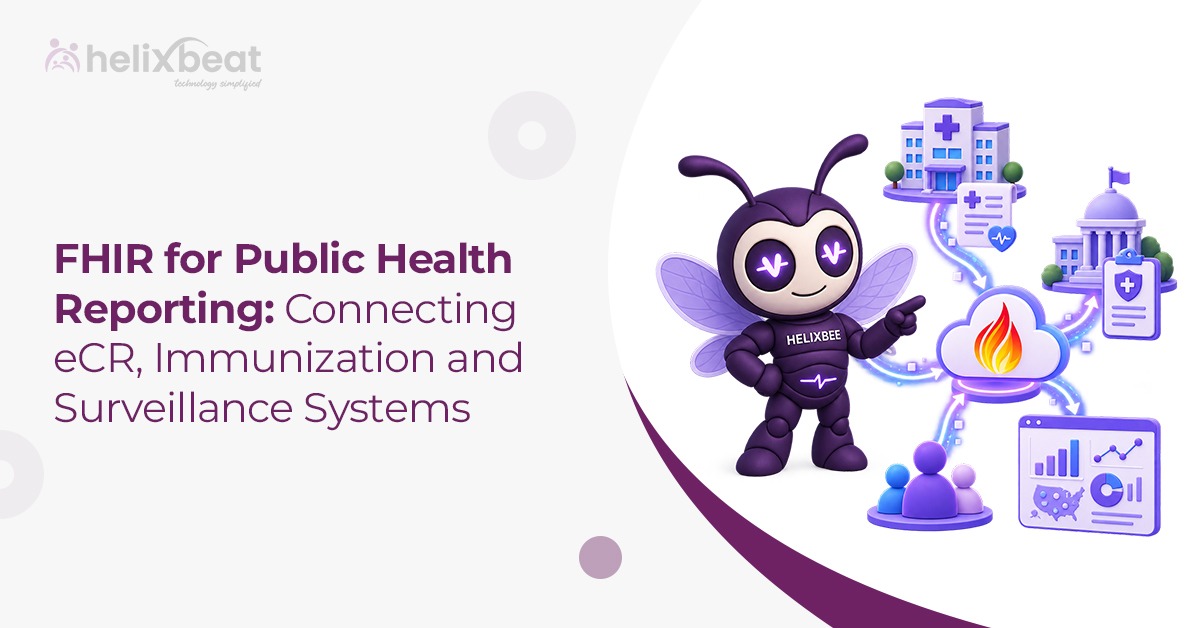
Public health teams still lose hours chasing data that should already be in front of them. A case report sits in one system. Immunization records live in another. Syndromic surveillance feeds trickle in through a third. FHIR public health reporting is slowly closing those gaps.
It’s already reshaping how electronic case reporting (eCR), immunization registries, and disease surveillance systems talk to each other. Therefore, knowing where this standard actually stands today matters more.
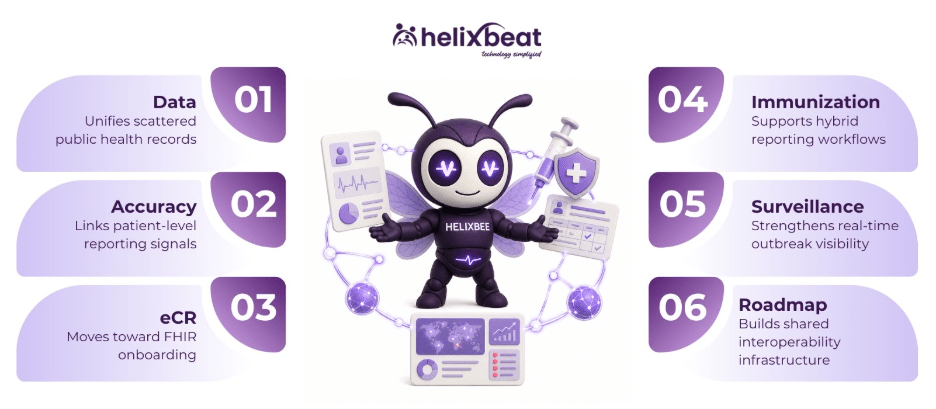
Getting FHIR public health reporting right is about accuracy at the patient level. A positive lab result, a vaccine dose, and a surveillance signal should all point back to the same person — without three separate teams reconciling records by hand.
Table of Contents
What FHIR Public Health Reporting Actually Involves?
FHIR (Fast Healthcare Interoperability Resources) is an API-based standard for exchanging clinical data. It breaks information into discrete “resources” that any compliant system can request, read, and act on through REST APIs.
Public health reporting has traditionally run on older formats. FHIR public health reporting doesn’t replace these overnight. It layers a modern, web-friendly exchange method on top of workflows agencies have run for years. The result is a gradual transition, not a switch flip.
FHIR eCR Implementation: Where It Actually Stands
Electronic case reporting automates the flow of reportable conditions from EHRs to public health agencies. The current national guide, HL7 FHIR eCR US Realm v2.1.2, runs on FHIR R4. It defines how an EHR builds an electronic initial case report and receives a reportability response.
Most eCR traffic today still moves as CDA-based eICR documents. It travels through the APHL Informatics Messaging Services (AIMS) platform, which connects all 50 states and several territories to receiving jurisdictions. But ONC certification rules now require developers to support either the CDA or the FHIR eCR standard starting in 2026. Therefore, FHIR eCR implementation is clearly the direction new onboarding is headed, while the older format still carries most volume. This shift is one of the clearest signals of where FHIR public health reporting is going next.
FHIR Immunization Reporting: A Slower, Steadier Shift
Immunization Information Systems (IIS) trail eCR on FHIR adoption. The current CDC- and AIRA-recognized national standard for IIS messaging is still HL7 v2.5.1, Release 1.5, published back in 2018. It reflects how deeply v2.5.1 is wired into provider workflows nationwide.
However, FHIR immunization reporting is growing at the edges. Bulk FHIR APIs let jurisdictions pull large immunization datasets for analytics work. SMART Health Cards, built on FHIR, give patients a verifiable, portable vaccination record. Likewise, the Immunization Integration Program by CDC now runs FHIR conformance testing alongside its existing HL7 v2 testing tools.
Therefore, the near-term reality is a hybrid setup: v2.5.1 handles routine reporting while FHIR APIs handle bulk queries, patient-facing tools, and newer decision-support features.
Healthcare Surveillance Data Exchange Gets a New Backbone
Syndromic surveillance is the real-time tracking of emergency department and urgent care visits. It still runs mainly on HL7 v2.5.1 messaging guides published by the National Syndromic Surveillance Program. While a FHIR-based trial guide exists for early adopters, it hasn’t replaced the production standard yet.
Where FHIR is moving faster in surveillance is MedMorph, the reference architecture for automating clinical-to-public-health data flows. MedMorph already supports FHIR-based reporting for chronic Hepatitis C surveillance, central cancer registries, and national health care surveys. It leans on FHIR R4, US Core, Bulk Data, and SMART App Launch specifications. It’s the same building blocks showing up across eCR and IIS modernization work. That shared foundation is what connects healthcare surveillance data to the rest of FHIR public health reporting.
Why Connecting These Three Systems Actually Matters?
eCR, IIS, and surveillance systems collect overlapping data about the same patients, often for the same outbreak. When they run on incompatible formats, agencies re-key data by hand, miss patterns across sources, and lose the hours that matter most during an outbreak response.
FHIR public health data exchange gives these systems a shared resource model to build on. For example, a Patient resource in an eCR report can align structurally with a Patient resource in an IIS query. A Condition resource from surveillance data can map to the same terminology sets used in case reporting. That structural consistency is what public health interoperability is really about.
What This Means for Your Organization?
If you lead health IT or public health informatics work, treat FHIR public health reporting as a direction. A practical roadmap starts small. Plan certification work around the 2026 ONC eCR requirements. Track IIS bulk data pilots active in your jurisdiction. Watch MedMorph use cases for surveillance patterns worth adapting locally.
A standards-conformant FHIR server, like FUSION, can support eCR, immunization, and surveillance workflows from one infrastructure layer. That beats running three separate integration projects side by side.
Agencies and vendors who treat connection as the goal, not certification as the finish line, will get more out of FHIR public health reporting.
Ready to Build a More Connected Public Health Infrastructure? Get in touch with us!
FAQs
1. What is FHIR public health reporting, and why does it matter now?
FHIR public health reporting refers to using the FHIR standard to move case reports, immunization records, and surveillance data between healthcare providers and public health agencies. It matters now because ONC certification rules and CDC modernization projects are actively pushing FHIR adoption timelines forward through 2026 and beyond.
2. Is FHIR replacing HL7 v2 for immunization and surveillance reporting?
Not yet, and not fully. HL7 v2.5.1 remains the current national standard for both IIS messaging and syndromic surveillance. FHIR is expanding around it, mainly for bulk data access, patient-facing tools, and newer public health projects like MedMorph.
3. What’s the difference between eCR and FHIR eCR implementation?
eCR is the overall process of automatically sending reportable case data to public health agencies. FHIR eCR implementation refers specifically to building that workflow using the HL7 FHIR eCR Implementation Guide instead of the older CDA-based eICR document format.
4. Do all states support FHIR-based eCR yet?
All 50 states and several territories connect to the APHL AIMS platform for eCR, but most active traffic still uses the CDA eICR format. FHIR eCR support is expanding as EHR vendors update their systems to meet 2026 certification requirements.
5. How does FHIR immunization reporting work with SMART Health Cards?
SMART Health Cards use FHIR resources to package verifiable, portable immunization records that patients can store and share digitally. They sit alongside the HL7 v2.5.1 messaging that IIS platforms use for core data submission.