

A patient gets discharged at 2 p.m. Their primary care doctor doesn’t see the discharge summary until the next morning. However, everyone involved would swear their systems support real-time healthcare data exchange. And technically, they do.
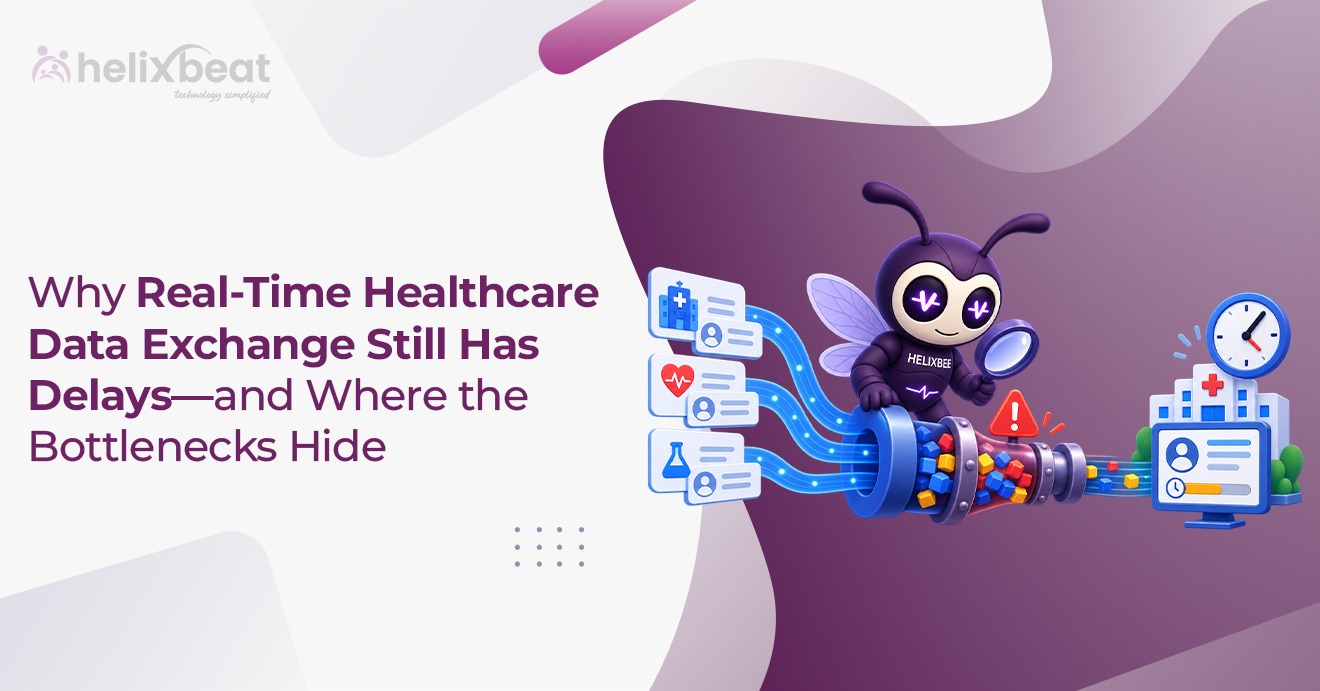
The gap isn’t the technology on paper. It’s everything sitting quietly between two systems that both claim to be “real time.” Interfaces still batch overnight. Patient matching still needs a human glance. Consent checks still take a beat. None of these show up in a vendor demo, but each one adds minutes to the data that was supposed to move instantly.
Here’s where the delays actually hide, stage by stage.
-
Table of Contents
The Message Leaves the EHR, But Not Right Away
Most hospitals still route clinical events through an interface engine built on HL7v2 messaging. In theory, an admission or discharge triggers a message the moment it happens.
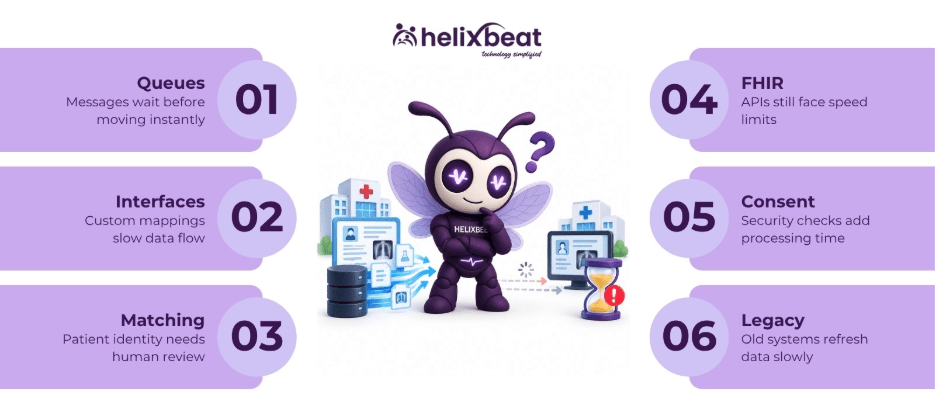
In practice, many interface engines queue messages and process them in batches, sometimes every few minutes, sometimes on an overnight schedule left over from an older integration project. These HL7 message delays rarely show up in uptime reports, because the system is technically “up.” It’s just not pushing data the instant it’s generated. Modernizing that interface layer is usually the fastest way to close this specific gap.
-
Every Point-to-Point Interface Adds a Translation Tax
A hospital with fifteen connected systems rarely has one integration. It often has dozens of custom, point-to-point interfaces, each with its own mapping rules for how fields translate between systems.
Every mapping is a place where a message can sit in a queue, fail silently, or wait for a developer to fix a formatting mismatch. This is one of the biggest hidden drivers of healthcare data latency: not the network, but the number of custom translation layers a single message must pass through before it reaches a useful destination.
-
Patient Matching Still Needs a Human Check
Real-time data exchange assumes the receiving system instantly knows which patient a record belongs to. That assumption breaks constantly.
Names get misspelled. Addresses change. Two patients share a birthday and a similar name. Most master patient index systems flag ambiguous matches for manual review rather than guessing. That review queue is often the actual bottleneck standing between an event happening and a clinician seeing it.
-
FHIR APIs Aren’t Automatically Real-Time
FHIR was built to make clinical data exchange more standardized and web-friendly than HL7v2 ever was. It succeeded at that. It didn’t automatically solve the speed problem.
A FHIR data exchange call can still hit rate limits, pagination on large result sets, or a bulk export job that was designed to run as a scheduled batch. Bulk data export in particular is intentionally asynchronous by design, which is efficient for large datasets but is not the same thing as real time. Therefore, confusing the two is one of the more common planning mistakes health IT teams make.
On top of that, FHIR server performance needs to be actively monitored, because a server can be technically online while still responding too slowly to count as real time.
-
Security and Consent Checks Add Their Own Latency
Every legitimate access request now has to clear authentication, authorization, and increasingly, a purpose-of-use and consent check before data moves. Under frameworks like TEFCA, that check exists for good reason: patient data shouldn’t move just because a network connection exists.
But OAuth token exchange, scope validation, and consent verification all take processing time. None of it is wasted work. It’s still latency that the patient and provider both feel, where multiple systems need to verify permission before a single record is released.
-
Legacy Systems Still Run on Batch Cycles
Many hospital systems, particularly older lab, radiology, and billing platforms, were never built with real-time messaging in mind.
But layering a modern API on top doesn’t change how often the underlying data refreshes. The API might respond instantly. The data behind it can still be hours old. This mismatch between an interface’s speed and a data source’s actual refresh rate is one of the most overlooked causes of delay in clinical data integration projects.
-
Clinical Data Doesn’t Just Need to Move, It Needs to Match
Even when a message arrives instantly, it isn’t automatically usable. Lab results coded differently across two systems, medication names that don’t match a shared vocabulary, or a diagnosis using a different code set all need reconciliation before a clinician can trust what they’re looking at.
This semantic gap is why clinical data integration is a harder problem than transport speed alone. Terminology mapping between coding systems like LOINC, SNOMED CT, and ICD-10 often still requires review. AERIS tackles this bottleneck directly by automating complex crosswalks between LOINC, SNOMED CT, and ICD-10. Instead of burdening clinical teams with manual review, AERIS harmonizes disparate code sets into trusted, FHIR-standardized records in real time.
What This Means for Healthcare Organizations Right Now?
None of this is a case against real-time healthcare data exchange. Standards like FHIR and frameworks like TEFCA have shortened the path between two systems. As a result, more organizations join nationwide exchange networks every year, and that trend is accelerating.
The honest takeaway is “real time” is a chain, not a single switch. A discharge summary might clear the EHR instantly, sit in an interface queue for four minutes, wait on a patient-matching review for an hour, then reach the receiving system with a coding mismatch that needs a human look. Each link has its own delay profile, and fixing only one won’t fix the patient’s experience.
Organizations aiming to close this gap must audit the full chain, not just the API layer.
The Bottom Line
The technology isn’t failing because the standards are wrong. It’s slowed by a series of smaller, less visible steps that each add their own delay. Finding where those steps live, and fixing them in the right order, is what actually turns “technically real time” into data a clinician can trust the moment they need it.
Ready to eliminate the hidden latency in your clinical workflows? Schedule a consultation with Helixbeat today.
FAQs
- What is real-time healthcare data exchange?
It refers to clinical or administrative data moving between systems, like EHRs, lab systems, or health information exchanges, close to the moment it’s generated. True real-time exchange means a receiving system sees the update within seconds.
- What causes the most healthcare data latency in practice?
No single cause dominates. Batch-based interface engines, manual patient-matching review, consent and security checks, and terminology reconciliation between coding systems each add their own delay, and they tend to stack rather than happen in isolation.
- Why do HL7 message delays still happen if HL7 has been around for decades?
HL7v2, the most widely deployed version, was originally designed around batch-style file transfers. But many interface engines process messages in scheduled intervals, even though the underlying protocol can technically support faster delivery.
- Is FHIR faster than HL7v2 by default?
Not automatically. FHIR is a more modern, web-friendly standard, but a FHIR-based system can still introduce delay through rate limits, large bulk export jobs, or backend systems that only refresh their source data periodically. The standard enables speed; it doesn’t guarantee it.
- Does patient matching really slow down clinical data integration?
Yes, often more than people expect. When a matching algorithm can’t confidently link a record to the right patient, most systems route it to a manual review queue rather than guessing. That queue is a common, underestimated source of delay.