

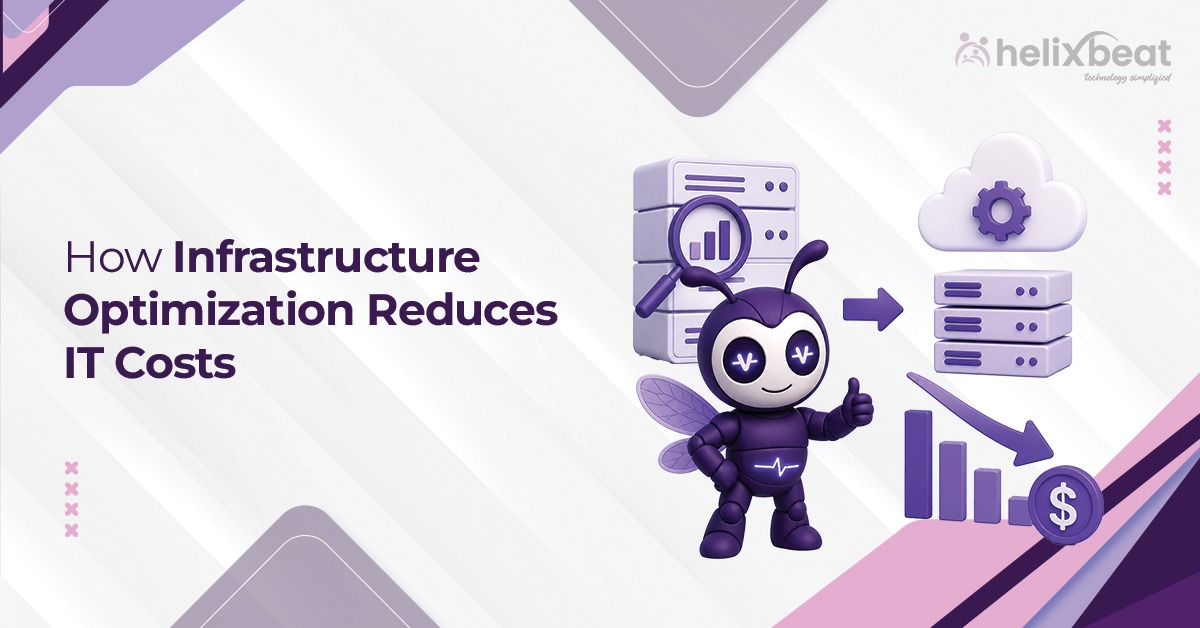
There is a moment most IT leaders recognize: the monthly infrastructure bill arrives, and the numbers don’t match the value delivered. Servers running at 10% capacity. Software licenses nobody touches. On-premises hardware demanding full-time maintenance. And yet, new workloads keep getting stacked on top of an already strained foundation. This isn’t a budgeting problem. It’s an infrastructure problem.
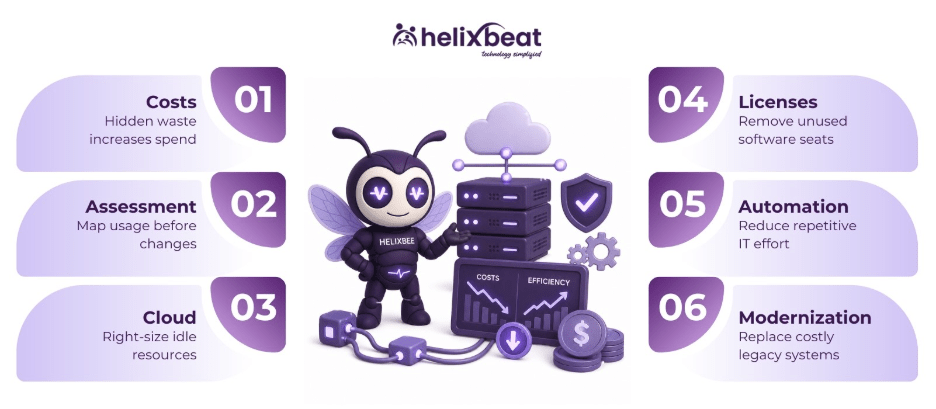
However, companies that invest in IT infrastructure optimization consistently report big cost reductions within the first year, making it one of the highest-ROI initiatives an IT team can pursue.
Table of Contents
Why IT Infrastructure Costs Spiral Out of Control
IT costs don’t balloon overnight. They build gradually through reactive purchasing decisions, vendor sprawl, underutilized resources, and systems that were efficient five years ago but are quietly expensive today.
According to research, organizations waste 20-30% of cloud spend on idle resources and oversized instances alone. Add on-premises hardware, redundant software licensing, and inflated staffing overhead, and the total waste across a typical mid-sized enterprise becomes hard to ignore.
Three root causes drive most runaway IT spend:
Resource underutilization: Servers are provisioned for peak load, but organizations pay for that capacity 24/7 even when real usage hovers at 10-15%.
Technical debt: Legacy systems need expensive maintenance, specialized talent, and workaround integrations that compound in cost every year they’re deferred.
Lack of spending visibility: Without a live picture of what infrastructure is consuming and delivering, decisions get made on assumptions rather than facts.
IT infrastructure optimization attacks all three of these simultaneously. It starts with a clear-eyed assessment of what you actually have.
The Foundation: A Real Infrastructure Assessment
Before meaningful optimization can happen, you need an honest picture of your current environment. A thorough infrastructure assessment is a diagnostic that maps every system, workload, and cost against actual business requirements.
A proper assessment uncovers:
- Workloads that are massively over-provisioned relative to their real demand
- Software licenses paid for monthly that nobody has opened in six months
- Redundant tools across departments doing the same job at double the spend
- Security vulnerabilities in aging systems
- Network bottlenecks quietly inflating support ticket volumes
Organizations that skip this step and go straight to purchasing new technology often replicate the same inefficiencies at a higher price.
The Core Levers of IT Infrastructure Optimization
Once you have a clear baseline, IT infrastructure optimization becomes a structured program. Here are the areas that consistently deliver the highest ROI.
Server Consolidation and Virtualization
Physical servers cost money to purchase, power, cool, and maintain. However, virtualization enables multiple workloads to run on a single physical host. Organizations that consolidate this way typically see 30-50% reductions in hardware costs, with proportional drops in energy and data center facility expenses.
Right-Sizing Cloud Resources
Cloud adoption has created over-provisioned instances that were set up for a project peak and never adjusted. Right-sizing means matching compute, memory, and storage to actual usage patterns, not worst-case theoretical load.
Cloud migration services move workloads to the cloud in a way that’s designed for cost efficiency from day one.
License Optimization
Enterprise software licensing is one of the most overlooked sources of IT overspend. ERP systems, collaboration suites, and security platforms often carry per-seat contracts that expand with headcount but never contract when people leave. A licensing audit identifies seats to eliminate and contracts to renegotiate at renewal, with an impact that shows up immediately on the next invoice.
Automating Repetitive IT Operations
Every manual process in IT operations carries a hidden labor cost. Patch management, backup verification, incident triage, and system health checks handled manually consume engineering time that could be directed at higher-value work. Workflow automation converts these recurring tasks into automated pipelines, which reduces both overhead and the human error rate.
Eliminating Zombie Systems
Zombie systems are silent budget drains. Research consistently shows that 20-30% of enterprise servers qualify as zombies at any given time. Therefore, decommissioning them is one of the fastest wins available through IT infrastructure optimization.
When Infrastructure Modernization Becomes the Right Move
IT infrastructure optimization has real limits when the underlying systems are fundamentally outdated. That’s where infrastructure modernization shifts from a technical ambition to a financial necessity.
Legacy systems cost more to operate each year. They demand rare and expensive skills. They integrate poorly with modern platforms, forcing custom workarounds that pile on cost. And they carry a higher security risk profile.
Legacy system modernization replaces or refactors these components with cloud-native alternatives. Modernization also unlocks pricing models — auto-scaling, serverless computing, and consumption-based contracts.
However, the transition requires upfront investment, so sequencing matters. Therefore, a structured technology roadmap identifies which legacy systems are costing the most and prioritizes modernization to generate early financial wins.
What Good IT Infrastructure Optimization Actually Delivers
IT infrastructure optimization produces outcomes that are measurable and visible to leadership, not just to the IT team:
- 20-40% reduction in infrastructure operating costs through consolidation and right-sizing
- Fewer unplanned outages as modern, well-monitored systems replace aging ones
- Lower IT support overhead as automation reduces incident volume
- Faster, more flexible procurement as legacy contracts give way to scalable cloud agreements
- Improved security posture that reduces breach-related costs, which can reach millions per incident
IT cost optimization services tie every infrastructure decision to measurable financial metrics.
Where to Begin
If cost spikes that don’t make sense, aging hardware, cloud bills that keep climbing, licensing agreements that predate your current team, the first move is not a vendor conversation. It’s an accurate picture of where you are today.
An infrastructure assessment builds that picture. From there, IT infrastructure optimization becomes a financially grounded, prioritized program rather than a string of reactive purchasing decisions.
Organizations that reduce IT costs build systems that are right-sized, modern, and matched to what the business actually needs to grow.
FAQs
1. What is IT infrastructure optimization?
IT infrastructure optimization is the systematic process of analyzing and improving an organization’s IT systems to maximize performance, eliminate waste, and lower operating costs without compromising reliability or security.
2. How does an infrastructure assessment differ from an IT audit?
An IT audit focuses on compliance and risk controls. An infrastructure assessment examines operational performance, resource utilization, and cost efficiency.
3. How long does an infrastructure assessment typically take?
For a mid-sized company, a thorough assessment usually takes two to four weeks. Larger enterprises with complex multi-cloud or hybrid environments may require six to eight weeks for a comprehensive review.
4. What is the difference between infrastructure optimization and infrastructure modernization?
Optimization works within the existing environment to eliminate waste and improve efficiency. Modernization replaces outdated components with newer architectures.
5. How does cloud migration reduce infrastructure costs?
Cloud migration shifts capital expenditure on hardware to consumption-based operational expenditure. Organizations pay for what they use, scale up or down without procurement cycles, and eliminate data center overhead.