

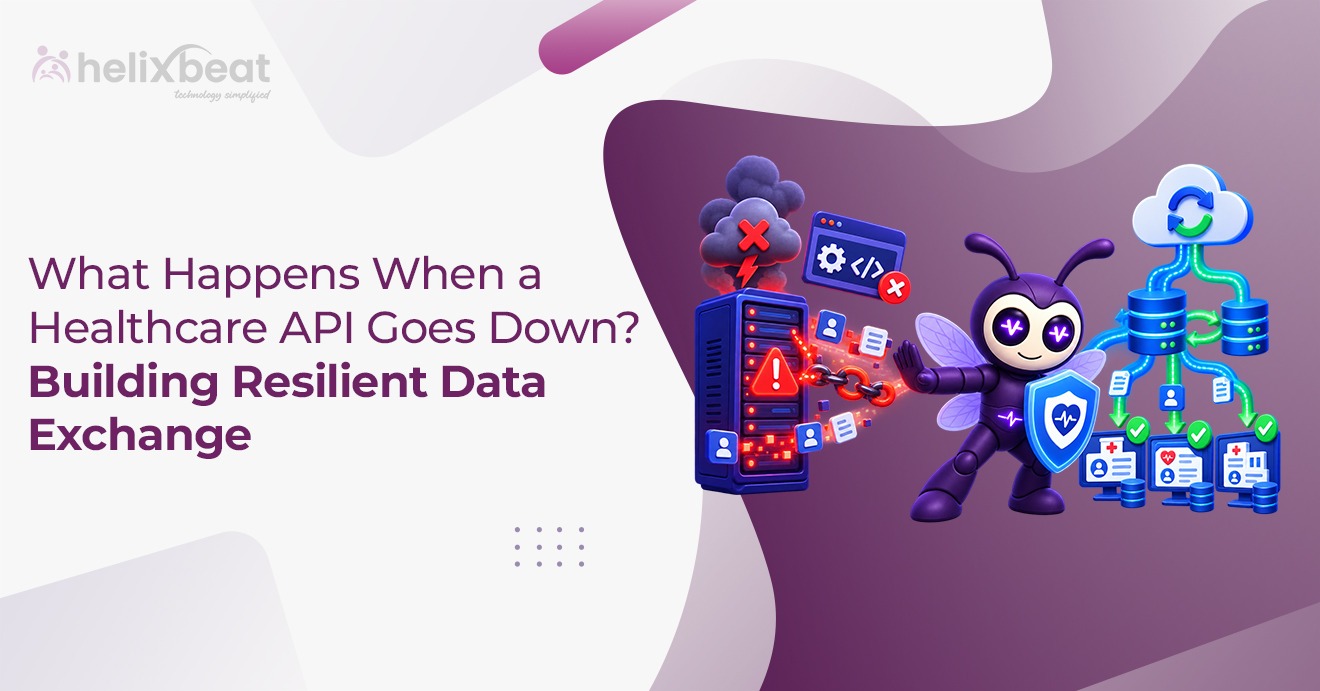
It’s the middle of a night shift. A nurse pulls up a patient’s chart to check an allergy before administering a new medication. The screen spins, then times out. The FHIR API behind the patient portal and the EHR has gone quiet. Nobody is entering new data, and nobody is retrieving it either. For the next few hours, the hospital runs on paper and memory.
This is the moment healthcare API reliability becomes a patient-safety problem. Every API eventually fails, and no vendor promises otherwise. However, what separates a resilient health system from a fragile one is what happens next around that failure. Healthcare API reliability isn’t the absence of failure; it’s how well a system contains one.
Table of Contents
“Down” isn’t always all-or-nothing
Healthcare API downtime rarely looks like a clean outage. More often, it’s partial. A patient resource loads, but medication history doesn’t. Requests succeed but take 40 seconds instead of half a second. A terminology server times out, and every request that needs a coded value fails, while everything else keeps working.
Therefore, a system that returns incomplete data is arguably worse than one that’s honestly offline, because nobody realizes there’s a problem until much later. This gap between “technically up” and genuinely reliable is where most healthcare API reliability programs fall short.
Why healthcare APIs go down in the first place
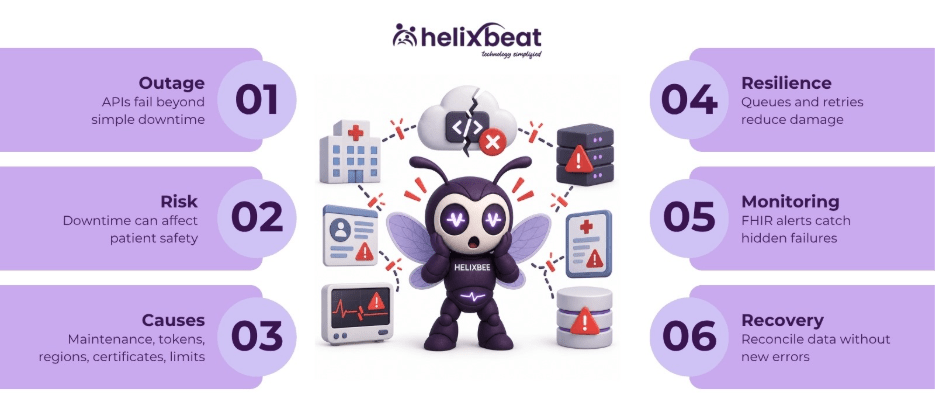
A handful of recurring vulnerabilities quietly erode healthcare API reliability.
- Upstream, scheduled EHR maintenance windows trigger ripple effects across connected downstream systems.
- Identity providers behind SMART on FHIR authorization have their own outages. That locks out every app relying on that token flow, even if the FHIR server itself stays healthy.
- Cloud regions can fail. If your organization runs a single instance in a single region, that failure becomes your failure too.
- Certificates expire quietly and break TLS handshakes overnight.
- And finally, it’s easy to think a partner system crashed, but nine times out of ten, your app is just hitting a rate limit and getting throttled.
Each cause needs a different fix. That’s exactly why a single “is it up” check misses most threats.
What actually happens when the connection breaks
The clinical and operational fallout is well documented. Downtime procedures published by ASPR TRACIE describe how EHR unavailability forces staff back onto paper charts, delays medication administration checks, and can lead to canceled or postponed procedures.
Recovery is its own hazard. Once systems come back, staff face a backlog of data that needs reconciling by hand. That reconciliation often happens at the end of a long shift, exactly when transcription errors are most likely. Therefore, resilient healthcare data exchange isn’t only about staying online; it’s about limiting how bad the gap gets and how much manual cleanup follows it. Measured this way, healthcare API reliability has as much to do with recovery design as it does with preventing the initial failure.
Building integration resilience into the architecture
A few patterns consistently reduce the blast radius of an outage.
Asynchronous, queue-based exchange gives a system somewhere to put messages when the receiving end is unavailable. Instead of failing a lab result outright, the message waits in a queue and is delivered once the connection recovers.
Retries with backoff, paired with a circuit breaker, stop a failing dependency from being hammered by repeated requests. A circuit breaker temporarily stops calling a service that’s clearly struggling. It checks back periodically instead of adding load to an already-failing system.
Idempotent operations matter more than most teams realize. If a retry after a timeout can accidentally create a second copy of the same order or observation, the fix for downtime becomes a new data-quality problem. Therefore, making writes idempotent, so a retry gives you the same result rather than a duplicate, fixes that gap right away.
Cached, read-only access to the most safety-critical data gives clinicians something better than nothing during an outage. Therefore, allergies, current medications, and active problems are the fields worth caching first, even if the copy is a few minutes stale.
Each of these patterns is a small piece of the same discipline: treating integration resilience as a design requirement, not a response to the last incident. Together, they’re what healthcare API reliability actually looks like day to day.
FHIR API monitoring that catches problems before patients do
Most monitoring setups check whether a base URL responds. That tells you almost nothing about whether the API is actually usable. Therefore, FHIR resources include a purpose-built way to report exactly what went wrong: the OperationOutcome resource.
If you want real visibility, a simple uptime ping isn’t going to cut it. Smart monitoring actually cracks open that OperationOutcome payload instead of tossing it in the trash. It figures out whether you’re dealing with bad data validation, a permission block, or an outright server crash, and flags the right team right away. Therefore, running synthetic tests that mimic actual user journeys catches the subtle, partial failures that a green checkmark will happily overlook.
This is what FHIR API monitoring should mean in practice.
Recovering without creating a second incident
The outage ending isn’t the end of the risk. Systems coming back online often need to reconcile hours or days of missed updates.
A bulk data export approach is one practical way to catch a receiving system up on everything it missed. It does that in one controlled pass, instead of replaying thousands of individual requests and risking duplicates or dropped records.
Reliable healthcare data exchange treats recovery as a designed step, not an afterthought.
The Takeaway
No healthcare API stays up forever. Certificates expire, cloud regions fail, and vendors schedule maintenance at inconvenient hours. Therefore, healthcare API reliability is decided by three things: How much a system limits its own damage. How fast it tells the right people what actually broke. And how cleanly it catches up once the connection returns.
Partner with Helixbeat to strengthen resilience, monitoring, and recovery.
FAQs
- What does “healthcare API reliability” actually mean?
It means an API stays available, returns correct data, and responds fast enough for the clinical or administrative task at hand. Uptime alone doesn’t capture this. An API that’s technically online but returning slow or incomplete responses isn’t reliable in any practical sense.
- What’s the difference between healthcare API downtime anda slowAPI?
Downtime means requests fail outright, usually with a timeout or an error response. A slow API still returns correct data, just not quickly enough. Both disrupt care, but they need different fixes. Downtime often points to an infrastructure or dependency failure, while slowness usually points to load, database contention, or an inefficient query pattern.
- Why do healthcare APIs go down more than other industries’ APIs?
Healthcare APIs typically sit on top of more dependencies: EHR systems, identity providers for SMART on FHIR authorization, terminology servers, and third-party payer or lab systems. Each dependency is a separate point of failure. A single weak link, like an expired certificate or an identity-provider outage, can take down access even when the core FHIR server is healthy.
- What is a circuit breaker, and why does it matter for integration resilience?
A circuit breaker is a pattern that stops an application from repeatedly calling a service that’s already failing. Instead of retrying endlessly and adding load to a struggling system, the circuit “opens” and short-circuits further calls for a period. It then tests the connection again before resuming normal traffic.
- Why does idempotency matter during an outage?
When a request times out, a client often doesn’t know if it succeeded before failing. A naive retry can create a duplicate record, like two copies of the same lab result. Idempotent design makes a repeated request produce the same outcome as the first one, so retries are safe rather than risky.