

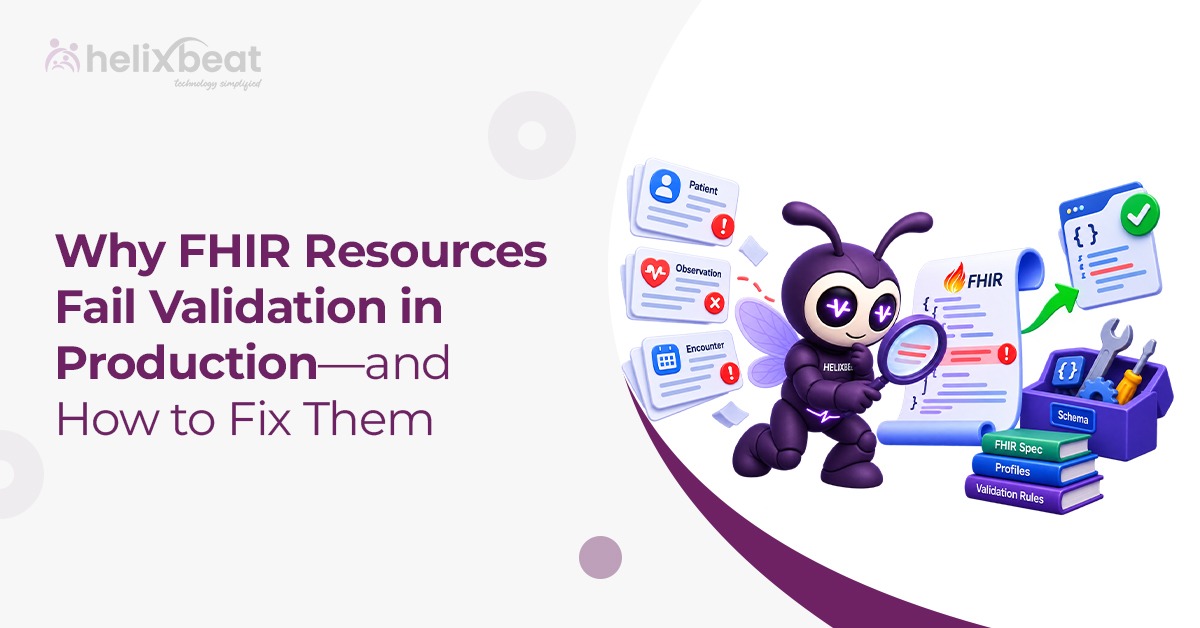
A team spends months building a FHIR interface. It sails through every test in the sandbox. The validator shows a clean result. But when the interface goes live, a chunk of production resources start bouncing back with cryptic OperationOutcome messages.
Therefore, FHIR validation is an ongoing check against real, messy, constantly shifting data. Most FHIR validation failures in production trace back to one of a handful of root causes, and each one has a practical fix.
Table of Contents
What FHIR validation actually checks?
FHIR resource validation works in layers. At the base level, a validator confirms that a resource is syntactically correct JSON or XML. It checks if data types match what the specification expects. It also checks whether required elements meet their cardinality rules. Above that sits terminology binding: does a coded field carry a value from the ValueSet it’s bound to? Above that sits FHIR profile validation: does the resource meet the specific Implementation Guide (IG) a trading partner expects? That’s the layer where FHIR validation becomes specific to your actual use case.
However, most teams only test the first one or two. Passing the base spec tells you almost nothing about whether a resource will be accepted downstream. Passing profile validation is the real bar.
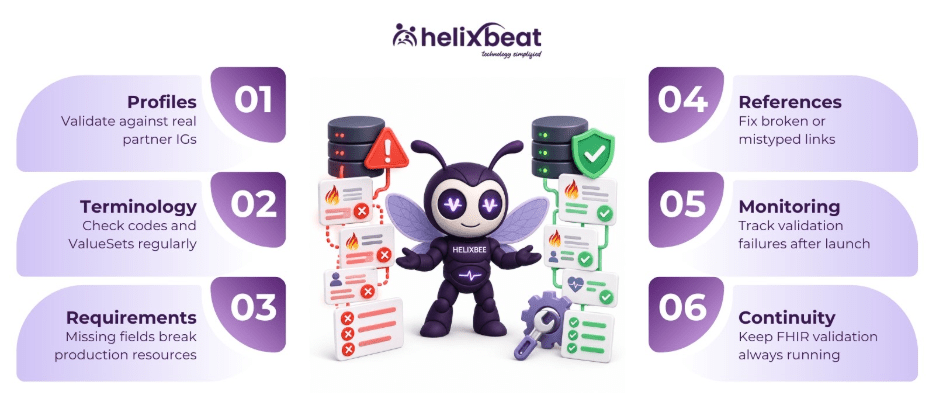
Why sandbox FHIR validation doesn’t predict production results?
Test data is clean by design because it was built to demonstrate a happy path. However, production data comes from decades of legacy systems. It comes from handwritten notes converted through OCR, and from HL7 v2 feeds that were never meant to map cleanly onto FHIR resources. That’s why organizations modernizing older HL7 integration pipelines run into this constantly.
However, there’s a second, quieter cause. Many teams treat FHIR validation as a single pre-launch checkpoint, run once against sample data and then left alone.
They validate against the base FHIR specification during development only to find out that trading partners expect conformance to US Core, a state HIE profile, or a custom IG the sandbox never loaded. Therefore, the resource was technically fine but just wasn’t fine for the profile that mattered.
The FHIR validation errors that show up most in production
A handful of categories account for most real-world failures.
Terminology binding mismatches. A code may look correct to a human but may not belong to the required ValueSet, or it references an outdated code system version. This is one of the most frequent sources of FHIR validation errors, especially with LOINC and SNOMED CT codes pulled from older lab and pharmacy systems.
Missing required elements. Base resources keep things flexible, but profiles don’t. Leave out an Observation.status or Patient.identifier, and that applied profile turns a previously optional field into an instant validation crash.
Profile and slicing failures. This is where most FHIR profile validation trouble concentrates. Slicing lets an IG say “this repeating element must contain exactly these named components.” However, extra, missing, or mislabeled slices trip up otherwise well-formed resources. A blood pressure Observation missing its diastolic component is a common example.
Broken or mistyped references. Either the reference points to a resource type the field doesn’t accept, or it’s a broken link because the resource was deleted or never created.
Format and extension issues. Malformed dateTime values, invalid narrative XHTML, and extensions that aren’t registered anywhere in the applicable IG package all cause trouble. These errors look confusing until you check them against the actual profile.
Closing the gap: how teams actually fix this
The fix isn’t a single tool. It’s a change in when and how validation happens.
Validate against the real target profile, not just the base resource. Load the exact IG package a trading partner uses, and re-validate whenever that IG version changes.
This catches most FHIR profile validation failures before they reach production. Regularly checking resources against the right profiles is one of the simplest habits that separates stable interfaces from fragile ones.
Move validation earlier, and make it continuous. Treat it as part of the build pipeline, not a pre-launch checklist. Continuous FHIR validation is what keeps interfaces stable over time. The testing and validation stage of a FHIR implementation works best as a repeatable step.
Use dedicated FHIR conformance testing tools alongside your own validator. Public tools like Inferno were built for US Core and ONC certification testing. Touchstone is used widely for Argonaut, Da Vinci, and CARIN testing. Both exercise scenarios that internal test suites often miss because they were built specifically to probe conformance edge cases.
Watch validation failures after launch, not just before it. A resource that validates cleanly today can fail tomorrow if a code system updates or a partner tightens their IG. Monitoring that goes beyond basic server uptime is what catches this kind of drift before it turns into a backlog.
Choose infrastructure that validates on write, with strictness you can configure. A FHIR server built with validation and conformance in mind can reject or flag non-conforming resources at the point of entry. That’s far cheaper than finding the problem downstream in a partner’s rejection queue.
Plan for regulatory change ahead of time. USCDI releases, CMS deadlines, and updated certification criteria keep moving the goalposts on profile validation. Therefore, teams that treat upcoming FHIR API requirements as a roadmap item spend far less time firefighting after a deadline passes.
The real takeaway
Passing FHIR validation doesn’t mean your data is safe forever. The standard isn’t built to be a one-time test. It works in layers:
- Schemas check the structure.
- Terminology bindings check the codes.
- Invariants and profiles check the business logic.
However, none of these can prove your data makes clinical sense on its own. Therefore, systems that actually hold up are the ones testing data continuously in the background. With FUSION, providers can add continuous FHIR validation and monitoring into their workflows.
To know more about our server, get in touch with us!
FAQs
- What is FHIR validation, exactly?
FHIR validation is the process of checking a FHIR resource against a set of rules before it’s accepted or shared. Those rules start with the base FHIR specification, covering syntax, data types, and cardinality.
- What’s the difference between FHIR resource validation and FHIR profile validation?
FHIR resource validation checks a resource against the base specification only: is it well-formed, are the data types correct, do required fields exist? FHIR profile validation goes further. It checks the resource against a specific Implementation Guide, including slicing rules, fixed values, and required extensions that the base spec doesn’t define.
- Why does a resource pass FHIR validation in testing but fail in production?
Test environments usually run against clean, curated sample data and often validate only against the base FHIR spec. However, production data comes from legacy systems, real clinical workflows, and messy historical records. It also gets checked against the actual profile a partner requires, which is frequently stricter than the base spec used in early testing.
- What are the most common FHIR validation errors?
The most frequent categories are terminology binding mismatches and missing required elements after a profile tightens cardinality. Slicing failures in repeating elements, broken or mistyped references, and malformed dates or unregistered extensions round out the list. Terminology and slicing issues tend to cause the most repeat failures over time.
- Does passing FHIR validation mean the data isclinicallycorrect?
No. Validation confirms structure, format, and conformance to a profile. It doesn’t confirm that the clinical content makes sense. A resource can pass every validation rule and still contain a diagnosis, date, or reference chain that’s clinically implausible.